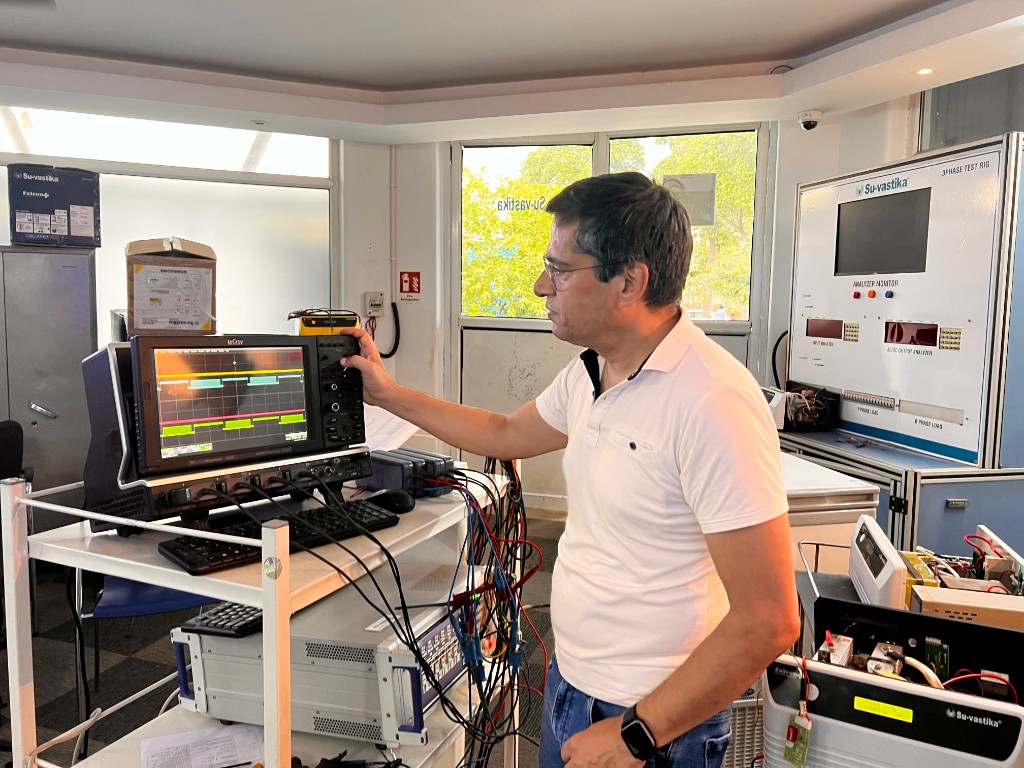
By a former associate of Kunwer Sachdev
When the Indian power backup market was booming in the late 1990s and 2000s, the unorganized sector operated on a simple, low-cost formula: reverse engineering. Manufacturers took heavy, humming metal boxes, stuffed them with crude copper and local transformers, slapped a brand name on the front, and hoped for the best. Nobody spent money on research and development, and intellectual property was treated like a luxury reserved for Silicon Valley software firms.
Kunwer Sachdev chose a fundamentally different path.
He operated with a singular conviction: if an Indian brand was going to compete on the global stage, it had to invent its own technology from the ground up. That relentless drive turned into 106 technology and design filings (77 at Su-Kam, 25 at Su-vastika, and 4 personal/AI-era filings) across his career—securing his position as India’s highest patent filer in the power backup, solar, and lithium energy storage sector.

The R&D Head’s Worst Nightmare: A Brain That Never Stopped
To understand how those filings came to be, you have to understand how Sachdev operated inside the R&D department.
He was constantly buzzing with new ideas, operating as if his brain never switched off. He was never satisfied with whatever technology the engineering team had just developed. The moment the R&D lab successfully completed a prototype, locked down the specifications, and prepared for commercial manufacturing, Sachdev would walk in with a handful of fresh modifications.
“What if we cut the weight by half?” “Can we make the circuit board smaller, smarter, and more efficient?” “Why are we doing it this way when we can do it five times faster?”
The head of R&D was perpetually exasperated, frequently throwing his hands up in despair and complaining, “When will this guy ever stop on one project?!”
For Sachdev, a finished product wasn’t an endpoint; it was just the starting point for the next iteration. While his engineers wanted stability, he wanted evolution. His mind was always racing ahead to the next efficiency metric, the next safety feature, or the next design breakthrough.
From Heavy Metal Boxes to the CHIC
That refusal to settle is what broke the mold of traditional manufacturing. In the early days, inverters were dangerous, shock-prone hazards that weighed a ton. When Sachdev pushed his team to design India’s first plastic-body inverter—the CHIC—competitors openly laughed. Industry veterans warned that plastic would melt under high ambient temperatures and that Indian consumers would never trust anything other than heavy iron sheets.
Sachdev didn’t just ignore the skeptics; he patented the structural mechanics and safety casing. That single innovation completely transformed how the country looked at power backup, eventually earning India Today’s “Innovation of the Decade” award. By owning the design, Su-Kam stopped fighting a race to the bottom on cheap manufacturing and started defining the category.
Moving from Square Wave to DSP Sine Wave Intelligence
The relentless tweaking didn’t stop at external casings. The interior technology underwent constant reinvention.
Early power backup systems pumped out crude square waves that frequently fried sensitive television boards, computers, and refrigerators. Sachdev pushed his R&D labs to pioneer MOSFET, microcontroller, and Digital Signal Processing (DSP) sine-wave technology. When they engineered grid-quality power for homes living on the edge of rolling blackouts, they patented the control topologies.
When the market was still heavily reliant on basic lead-acid backup, Sachdev was already pushing into solar. Years before national solar policies took shape, Su-Kam pioneered India’s first 3-phase Solar PCU in 2006—patented architecture designed to harness solar energy for households and commercial spaces. That thread continues in how Kunwer sparked India’s solar movement.
The Evolution: From Inverters to Lithium, Solar, and Electric Vehicle Electronics
The cycle didn’t end when the Su-Kam chapter closed. Transitioning to his next venture, Su-vastika, Sachdev’s restless engineering mindset immediately turned to the next generation of energy challenges:
- Solar Power Conditioning Units (PCUs): Maximizing efficiency through advanced high-voltage MPPT algorithms.
- Lithium Battery Energy Storage Systems (BESS): Replacing aging lead-acid chemistry with smart, long-lasting lithium storage designed specifically for developing market conditions.
- EV Electronics & Specialized Inverters: Powering heavy-duty lift systems, electric vehicle infrastructure, and specialized tractor inverters.
The second-chapter record is told more fully in From Su-Kam to Su-vastika.
The Verified Patent Record
Out of those 106 filings, every single patent represents a real-world bottleneck solved on the factory floor because an obsessive founder refused to accept “good enough”. Below are the milestone grants that map to the story above — not the full shelf. The complete, searchable register (every application number, title, and status drawn from the Indian Patent Office) lives on Solar Man of India’s patent archive.
Historical note on Su-Kam filings: after the 2019 insolvency, renewal fees on granted Su-Kam patents were not kept current and pending applications were not pursued under the new ownership. The rows below document what was invented and filed during Sachdev’s founder tenure — not current legal force or ownership. Search any application number at the Indian Patent Office public search.
Su-Kam era — landmark grants
| Application No. | Grant No. | Title | Why it matters |
|---|---|---|---|
| 722/DEL/2003 | 241612 | Digital Signal Processing Sine Wave Inverters | Foundational DSP sine-wave architecture — grid-quality backup instead of appliance-frying square waves |
| 2332/DEL/2007 | 285567 | A Colossal DSP Sine Wave Inverter (Single Phase) With RS-232 Mobile Interface and GSM Connectivity | Scaled sine-wave intelligence with remote connectivity |
| 1785/DEL/2007 | 284856 | DSP Controlled Triple Conversion Online UPS With Remote Monitoring | Online UPS-grade control for continuous, clean power |
| 2080/DEL/2007 | 291088 | A High Frequency Inverter | High-frequency topology — smaller, smarter power electronics |
| 940/DEL/2008 | 292773 | A MPPT Based Solar Charge Controller | Early MPPT solar charging — the solar-PCU thread before mass rooftop policy |
| 2651/DEL/2007 | 275276 | A Heavy-Duty Three Phase Inverter Particularly Used for an Application in the Telecom Industry | Three-phase / institutional duty cycles beyond the home UPS |
| 885/DEL/2009 | 292505 | User Settable Power Backup System With Multiple Output | Configurable backup for real household and commercial loads |
The plastic-body CHIC (India Today’s “Innovation of the Decade”) was the design-language breakthrough that made the category feel safe and modern; the DSP and MPPT grants above are the control-topology paper trail that sat underneath that era of products.
Su-vastika era — landmark grants
| Patent No. | Application No. | Title | Why it matters |
|---|---|---|---|
| 403377 | 202111051469 | Hand-Held Test/Comparison Device for Comparing | Factory-floor instrumentation — bottlenecks solved with tools, not slogans |
| 408390 | 202111030506 | An Improved Solar Grid Hybrid Subsystem Used With Power Backup Systems | Solar–grid hybrid conditioning for backup systems |
| 411360 | 202111047409 | An Intelligent Battery Equalizer | Cell/pack health for longer-lived storage |
| 423453 | 202111031331 | IoT-Based System and Method for Real-Time Monitoring and Control of Charging and Discharging of Renewable-Energy / EV Power Backup Systems… | Lithium / BESS / EV-era monitoring with backup-time intelligence |
| 432802 | 202111041646 | IoT-Based Battery Charge Equalizer for Equalizing the Charge of Batteries Irrespective of Their Type | Chemistry-agnostic equalisation for mixed fleets |
| 466373 | 202111047408 | An IoT-Based Hybrid Solar Charge Controller | IoT-era successor to the MPPT charge-controller line |
| 475993 | 202111033157 | An IoT-Based Solar Grid Hybrid Subsystem With Photovoltaic Power Generation and Backup Unit With Grid Feed Control | PV generation + backup + grid-feed control in one architecture |
| 436188 | 202011044810 | System for Real-Time Monitoring of a Battery Using Battery Management System | BMS monitoring filed in Kunwer Sachdev & Khushboo Sachdev’s names |
Full interactive register → For every Su-Kam and Su-vastika application number, filing date, prosecution status, and (where available) IPO certificate, open the complete archive at solarmanofindia.com/patents. Spot-check any row against the Indian Patent Office by application number.
Why Patents Matter for “Make in India”
True manufacturing sovereignty doesn’t come from assembly lines alone; it comes from owning the intellectual property. If Indian companies merely assemble components designed in Shenzhen, Germany, or Silicon Valley, they remain at the mercy of external supply chains and foreign margins.
Kunwer Sachdev proved that an Indian entrepreneur—starting with nothing on the streets of Delhi—could build world-class power electronics from scratch. You don’t just follow the rules of an industry.
You keep inventing until you have to write your own.
Further reading
- CHIC plastic inverter — India Today Innovation of the Decade
- India’s first DSP sinewave inverter
- Awards and recognition of Kunwer Sachdev
- From Su-Kam to Su-vastika
Disclaimer
Kunwer Sachdev is no longer associated with Su-Kam Power Systems Ltd. References to Su-Kam here are historical and biographical. His current work continues through Su-vastika and related ventures. Patent counts reflect figures stated publicly across those chapters; readers should verify current numbers with the relevant entities and patent offices.
InverterManOfIndia is an independent third-party editorial site. It is not owned, operated, sponsored, or endorsed by Su-Kam Power Systems Ltd., Su-vastika Systems Pvt. Ltd., or related parties.
Editorial Note · Independent Coverage
This article is part of an independent editorial series on invertermanofindia.com. It is written by a former associate of Kunwer Sachdev, drawing on first-hand observation during the period described and the public patent record cited above. It is not authored, ghost-written, edited or approved by Mr. Kunwer Sachdev, by Su-Kam Power Systems Ltd. as the company exists today, or by any current entity he leads. The views, framing and interpretations are the writer's alone. Full independence and dissociation policy: /disclaimer.
Disclaimer: invertermanofindia.com is an independent editorial legacy site.