By a former associate of Kunwer Sachdev
There is a small SlideShare deck that Su-Kam Power Systems uploaded several years ago. It is twelve slides long. It contains no fanfare, no narration — only certificates, trophies and ceremony photographs assembled in the matter-of-fact way a company secretary stacks paperwork in a binder. The deck is still on SlideShare, available to anyone who cares to look at it. (SlideShare — Awards and recognition achieved by Su-Kam Power Systems Ltd)
It is a remarkable document, but not for the reason most viewers assume. The point is not the number of awards. The point is that almost every one of them was earned because of one specific decision Mr Sachdev took, often years earlier, and almost always against the advice of the room. What the deck records are honours presented to Mr Sachdev or to Su-Kam under his leadership — trophies and citations that arrived from government ministries, trade bodies, and press panels. They are not the internal HR evenings where he stood on stage handing awards to his own employees.
A scope note: this legacy lists honours presented to Mr Sachdev personally or to Su-Kam Power Systems Ltd under his leadership — government citations, industry trophies, trade-body panels, press recognition, and the certificates that hung in the Gurgaon reception. It does not cover the internal HR ceremonies where Sir stood on stage handing trophies to employees at Sports Day, Long Service evenings, or the annual Employee Award Ceremony. Those belong in Life at Su-Kam. The distinction matters: what follows is what the world gave back, not what he gave out inside the building.
I joined him around 2000. Most of what follows happened on my watch — or close enough that I was in the building when the late nights began, when the audit teams arrived, when the bus left for a ceremony with half the sales office squeezed into the back row. Anyone who was inside during that period can read the record like a personal diary. The certificates may be addressed to M/s Su-Kam Power Systems Ltd. The decisions were his.
A small reading note before going further: a few of the older certificates carry the name Kunwer Deep Sachdev. That is the same person. Kunwer Deep Sachdev was the founder’s earlier name, which he later shortened to Kunwer Sachdev. Anyone reading the original documents will see both forms used.
First, the table stakes: the certifications no Indian inverter brand bothered with
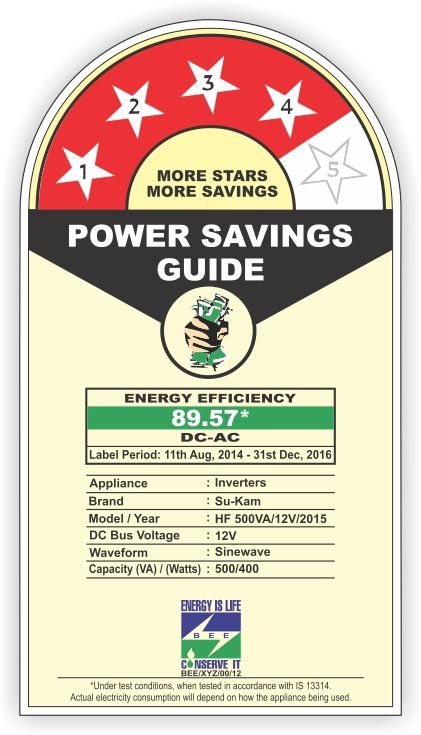
These are not trophies in the cabinet sense — they are certifications earned by Su-Kam under Mr Sachdev’s push for export-grade quality. The early record lists four that today look unremarkable: CE (for the European Union), UL (for the United States and Canada), ISO 9001 for quality management, and ISO 14001 for environmental management. Back when Su-Kam first earned them, for an Indian power-backup company, they were almost eccentric.
The Indian inverter market at the time was a domestic-only market by habit. There were no Indian inverter brands of any size selling into the EU. The unspoken rule on the shop floor was that the customer was inside India and the regulator was inside India, and chasing a CE mark cost money that could be better spent cutting another rupee off the bill of materials.
Mr Sachdev disagreed. He insisted, with the cheerful stubbornness that everyone around him eventually learned to plan around, that Indian manufacturing had to be exportable on its first day or it would never be exportable at all. The CE and UL certifications were the result. They did not arrive because the market demanded them. They arrived because he refused to let the team scope the future down to what the market currently asked for.
I was not in the room when the earliest CE paperwork went out — Sir spoke about that chase often, as something he had pushed through when the rest of the industry was still arguing about domestic margins. By the time I was sitting in ISO audit prep, I understood what those certificates had cost. The R&D benches stayed lit past nine. The quality team walked the Baddi floor with clipboards for weeks. Sir did not treat certification as a trophy hunt; he treated it as proof that the factory could survive scrutiny from people who did not care about our brand story. When the framed certificates finally arrived, he wanted the engineers who had stayed late in the photograph — not himself.
The export-led awards that followed — including the Sectoral Export Award from the Ministry of Commerce — are a downstream consequence of that one early call. The same instinct turned up later in the way Su-Kam went on to be adjudged Africa’s most reliable inverter brand and to export inverters even to China — markets the rest of the Indian industry had not been chasing.
The R&D awards: spending on research when the CFO wanted to cut it
The ELCINA-EFY Award for Excellence in Research & Development was presented to Su-Kam by a joint Government-and-industry panel that had shortlisted more than a hundred entries across India. Su-Kam was not a semiconductor company. It was not a defence contractor. It was, in the eyes of most analysts, a manufacturer of consumer power equipment. That a panel of this seniority gave it an R&D award says something the spreadsheets did not.
The decision behind it had been made years earlier. Su-Kam was, by some industry counts, filing close to two patents a month at its peak, and was the only power-back-up company in India to be recognised for its R&D by the Department of Science and Technology in New Delhi. (See the Indian Bill Gates profile on this site.) The reason that line item survived in the budget every year, when finance teams were instinctively reaching for it with a red pen, was that Mr Sachdev personally protected it. Engineers who worked on the touch-screen solar PCU, the battery life-cycle tester that was quietly a small revolution, the four-star BEE-rated inverter, and the early lithium street-light line all describe the same boss: someone who would happily lose an argument about marketing spend and absolutely refuse to lose one about R&D.
The ELCINA-EFY trophy on stage is a citation for engineering. It is also, if you were in the room when the budget meetings happened, a citation for that specific veto.
I was in those budget meetings — not at the head of the table, but close enough to hear Sir refuse the cut every single time. The months before the ELCINA shortlist, the R&D floor felt like an examination hall that never closed. Sir would walk the benches at odd hours, asking questions nobody had prepared for, not to humiliate anyone but to make sure the work could survive a panel that had seen a hundred other entries. On the night the award was confirmed, he did not make a speech in the office. He ordered lunch for the R&D team and told the senior engineers to stand in front when we took the group photograph. The organisers wanted his name on the citation. He wanted the people who had actually built the prototypes in the frame.
The Government of India award addressed to him by name
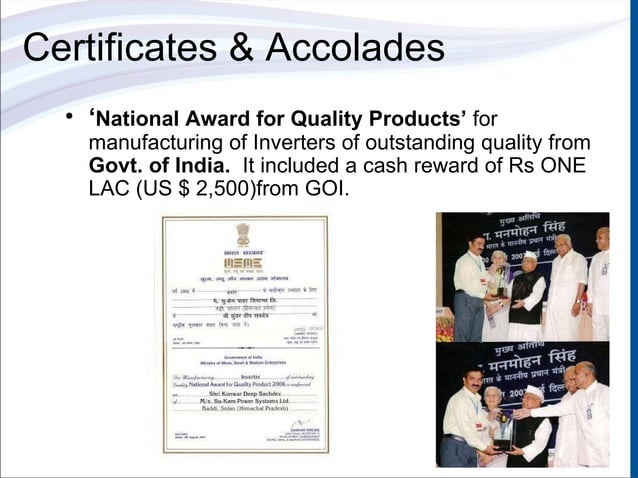
This is the award that ends the “the company won, not the founder” argument cleanly. The National Award for Quality Products was issued by the Ministry of MSME, Government of India, for outstanding manufacturing of inverters. It is explicitly issued in the name of Shri Kunwer Deep Sachdev / M/s Su-Kam Power Systems Ltd, Baddi, Solan (Himachal Pradesh). It carries a cash component of Rs 1 lakh. The ceremony was attended by then-Prime Minister Dr. Manmohan Singh. The photograph above is from that stage — the trophy being handed to Sir, not an internal presentation he made to staff.
You cannot read that certificate and conclude that this was a company award disconnected from its founder. The State of India put his name on it.
I was not on the Delhi stage for this one — the closest I came was the office buzz when the shortlist landed and the quality team stopped pretending they were not nervous. But I was in the building during the months of quality documentation that made the application possible, and I heard Sir talk about the ceremony afterward with a pride he rarely showed in public. Not boastful pride. The quiet kind. He kept saying the certificate had his name on it only because the government form required a signatory, and that the Baddi line had earned it shift by shift. When colleagues congratulated him in the corridor, he redirected every sentence toward the plant managers. That was his habit with every award that carried his name: accept it because the organisers insisted, then immediately hand the meaning back to the team.
The export award that was, underneath, a culture decision
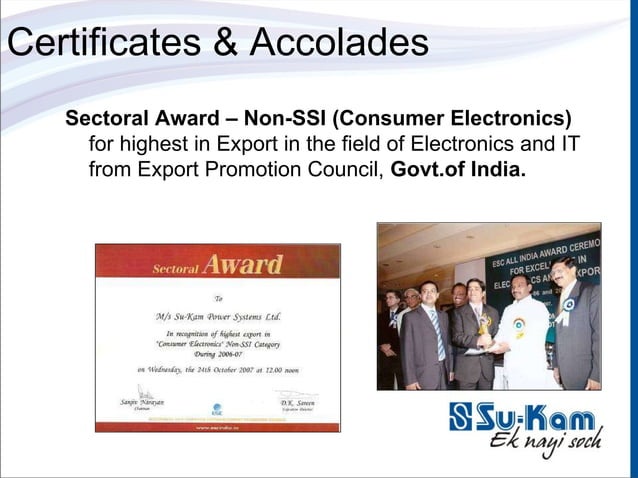
The Sectoral Award for highest exports in Consumer Electronics, conferred on Su-Kam by the Electronics & Computer Software Export Promotion Council under the Ministry of Commerce, is where the export bet placed years earlier finally cashed out. To win this category, Su-Kam had to be sending more inverters out of India than every other consumer-electronics exporter in the Non-SSI bracket. Mr Sachdev was on stage to receive it — the photograph shows the trophy being handed to him, not the other way around.
It managed this in part because the company had been quietly, painstakingly chasing African markets, Middle Eastern markets, and South Asian markets that the rest of the industry had not bothered to develop a sales muscle for — a story we have covered separately in Su-Kam’s impact on lighting up Africa. The relationships that produced this award were dealer relationships Mr Sachdev built in person, often on month-long trips that his peers refused to take.
I remember the export numbers being discussed in the office long before the Ministry ceremony. Sir had been on the road for weeks at a stretch — Africa, the Middle East, markets our competitors still treated as afterthoughts. When the Sectoral Award came through, he wanted the export desk and the logistics team at the front of the room, not the marketing department. We took a company bus to the felicitation. He sat in the second row. Afterward, at lunch, he went table to table thanking the boys who had packed the cartons and chased the shipping paperwork. He was genuinely happy — I could see it in the way he kept returning to the trophy without posing with it.
Business Superbrand — the trophy he received from L. K. Advani
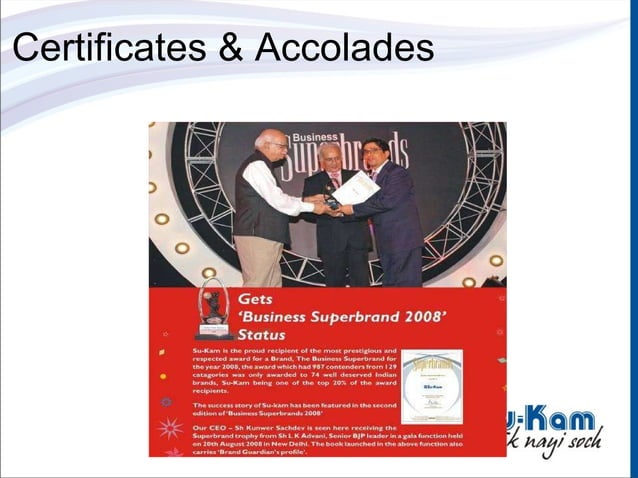
The Business Superbrand designation came after 987 brands contended across 129 categories. Only 74 made the cut. Su-Kam was one of them — and was, by several accounts, the first Indian power solutions company to earn the Superbrand label. (See the Indian Bill Gates profile on this site.) The trophy was presented to Mr Sachdev personally by Sh. L. K. Advani at a function in New Delhi. The book that accompanied the award carried his profile under “Brand Guardian.”
A Brand Guardian is not the company’s marketing manager. A Brand Guardian is the person whom the brand actually belongs to.
I was in the hall for this one. The organisers called his name from the stage — there was no ambiguity about who was meant to walk up. Sir went up because the protocol required it, not because he enjoyed being the face. Back at the office the next week, he kept the Superbrand book open on his desk and showed visitors the dealer stories inside, not his own profile page. He told the marketing team that the award belonged to every service engineer who had kept a promise in a small town at ten at night. That was not modesty as performance. That was how he actually thought about brand — as something the field earned, not something headquarters declared.
The Marico Innovation Award — for the business model, not the product
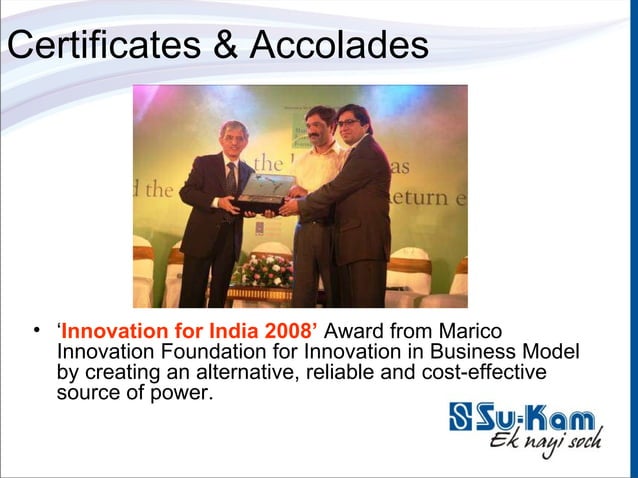
The Marico Innovation Foundation’s Innovation for India award was presented to Su-Kam — not for a product, but for Innovation in Business Model. (Marico Innovation Foundation — Indian Innovation Icons)
The citation noted Su-Kam’s creation of an alternative, reliable and cost-effective source of power. What it did not spell out, but what anyone inside the dealer network would have recognised instantly, was that the recognition was for the multi-thousand-dealer service-and-distribution architecture that Mr Sachdev had built — almost dealer by dealer — across India during a period when most competitors were content to ship to wholesalers and disappear. We have written separately about the way he ran those famous dealer meets that were equal parts marketing genius and live theatre. The Marico panel was, in effect, certifying that he had reinvented how an inverter business could go to market.
This one felt personal in the building. The dealer network was not an abstraction to us — it was the bus leaving for Ludhiana, the plastic chairs, the men Sir had sat with one by one. When the Marico award was announced, he did not frame it as a founder’s vindication. He framed it as proof that the service model worked — that you could win by keeping promises in the field instead of winning shelf space in a wholesaler’s godown. I watched him rehearse nothing for the ceremony. He did not need to. He had been making the argument in every dealer meet for years. Afterward, he asked that we print extra copies of the citation for the regional managers to carry into their territories. The trophy stayed in Gurgaon. The paper went on the road.
A second international stage
Mr Sachdev was felicitated at several international-brand-backed entrepreneur ceremonies during this period — evenings where Indian builders shared a stage with sponsors who treated them as peers rather than curiosities. I was not in the room for most of these. What stayed with me from the ones I heard about afterward was his description of sharing the stage with other builders who had also started from nothing. He did not come back from those nights talking about prestige. He came back talking about how an international brand had treated Indian entrepreneurs as equals. That mattered to him more than any photograph.
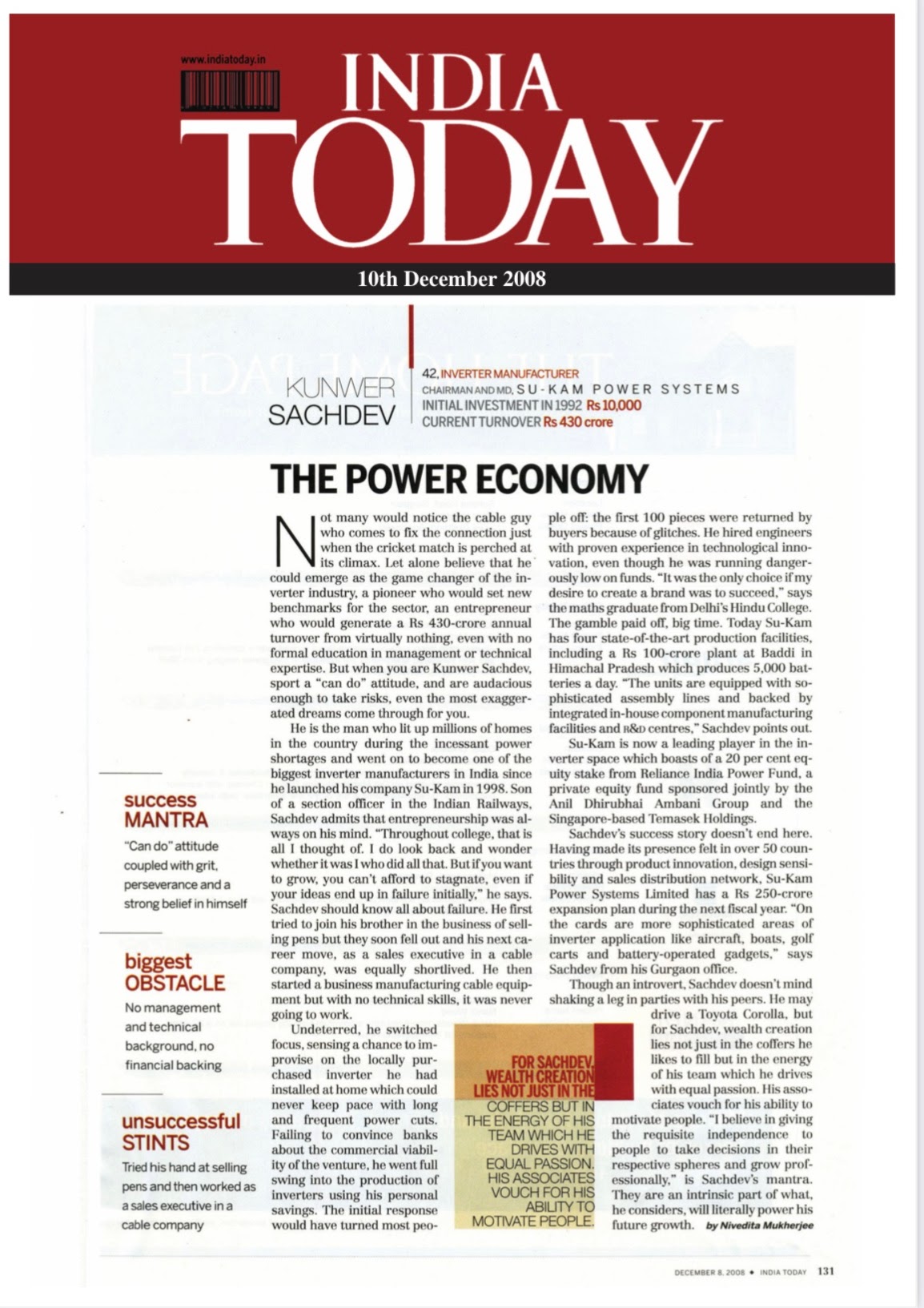
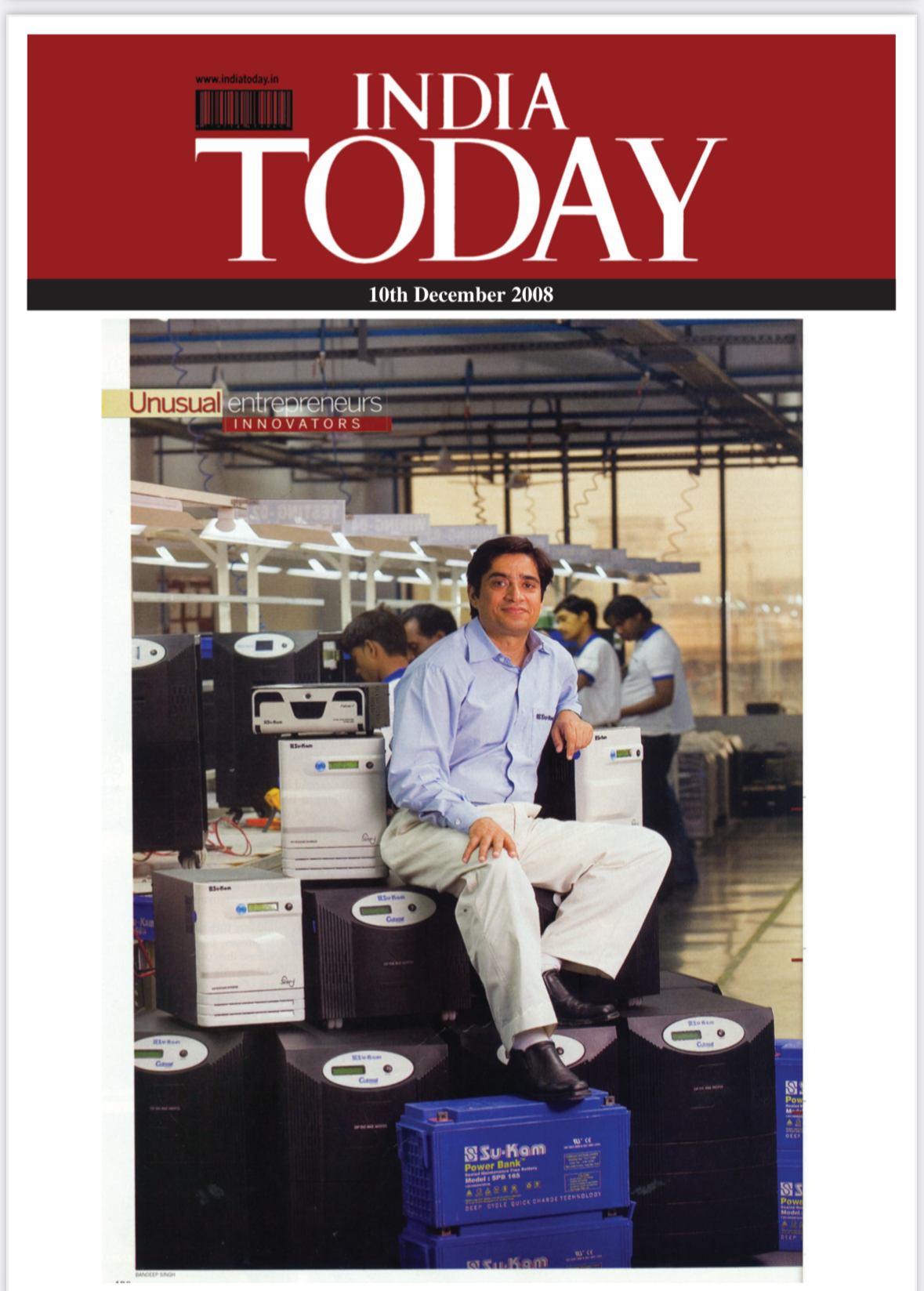
The press was paying attention too. India Today put Su-Kam on the cover under the headline The Power Economy — press recognition, not a trophy he received, but the kind that tells a founder the room outside the factory has started listening.
ISA Technovation — handed to him by a world chess champion

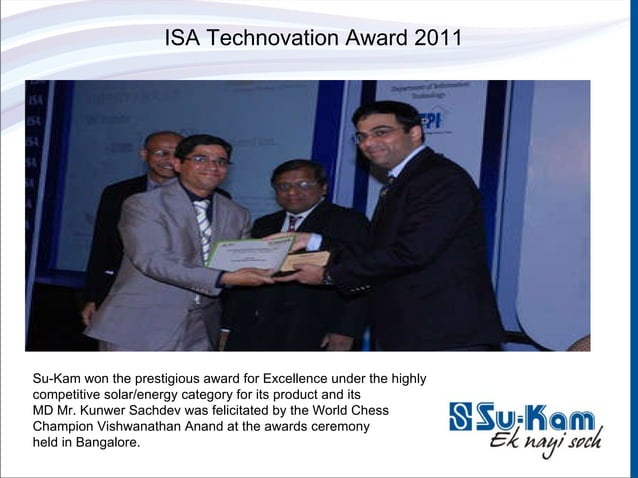
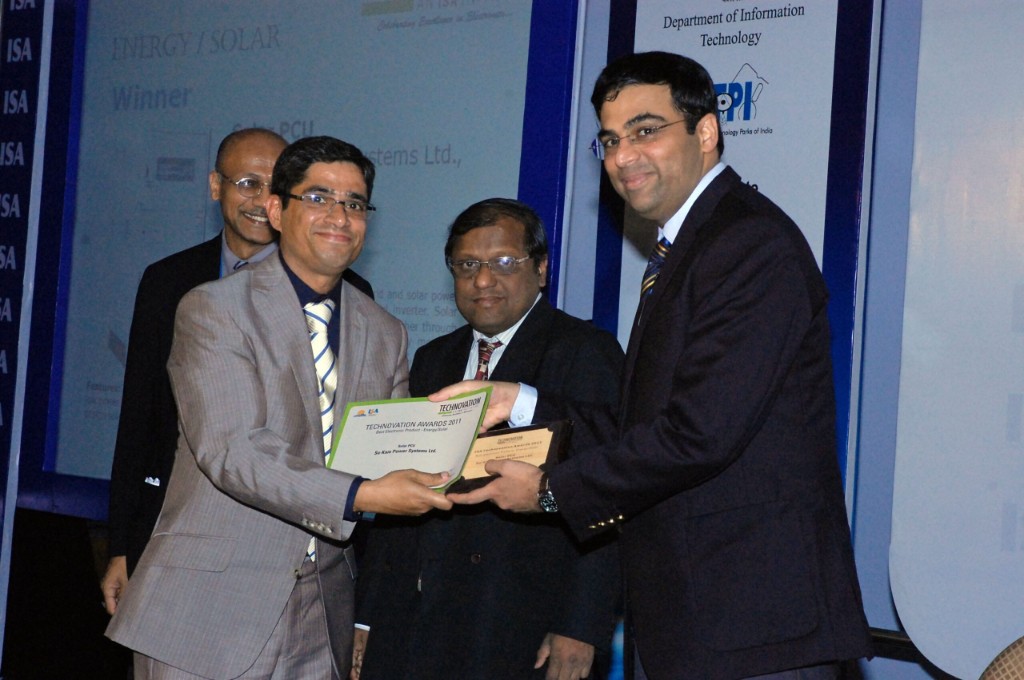
The India Semiconductor Association’s Technovation Award for the solar/energy category was presented to Su-Kam Power Systems Ltd for its solar PCU work. Mr Sachdev was on stage to receive it on the company’s behalf — the certificate names Su-Kam; the trophy was placed in his hands by Vishwanathan Anand, the five-time World Chess Champion, at the ceremony in Bangalore on 21 February 2011. The first photograph above is from that evening — not a SlideShare export, but the actual stage, with the award being handed to him.
Set aside the photograph for a moment and notice the category. Solar/energy, at that point, was a wide-open field in India, with players ranging from established multinationals to government-backed research labs. That a power-backup company from Gurgaon, headed by a founder who had never trained as an engineer, won the energy-category Technovation award is a fact that does not survive easy explanation. Mr Sachdev’s bet on solar — placed early, derided by some on his own board — was already producing certificates that even the semiconductor industry felt obliged to give him. The longer arc of that bet is captured in how Kunwer Sachdev sparked a solar revolution in India.
I flew to Bangalore for this ceremony with a small group from the solar team. Sir had been defending the solar line for years against people who thought it was a distraction from the core inverter business. When Vishwanathan Anand handed him the trophy, the room applauded the founder — and Sir, in the same breath, named the engineers who had built the solar PCU prototypes. I remember him holding the trophy for the photographers because the organisers needed a clean shot, then stepping aside so the team could be in the frame. That evening, over dinner, he was quieter than usual. Not subdued — satisfied. The kind of satisfied that does not need to be announced.
Entrepreneur of the Year
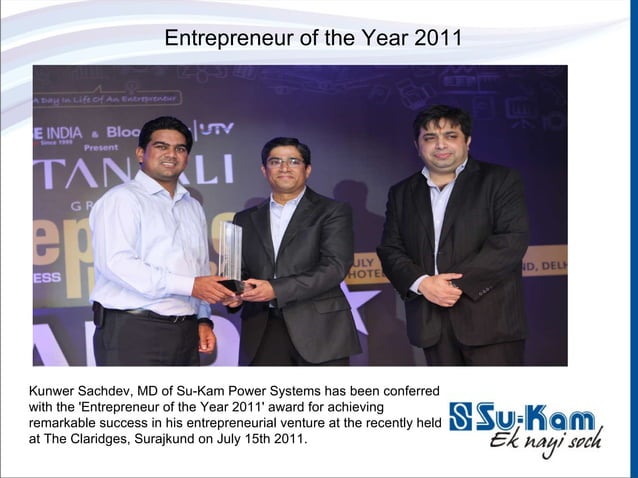
The Entrepreneur of the Year citation was conferred on Mr Sachdev personally at The Claridges, Surajkund, on 15 July 2011 — the photograph shows the trophy being handed to him on stage. Independent biographical sources also note the Ernst & Young Entrepreneur of the Year title, the Bharat Shiromani Award, and inclusion in Hurun’s list of India’s Most Respected Entrepreneurs. (Wikipedia — Kunwer Sachdev) For one founder to collect this many “Entrepreneur of the Year” trophies in a short span is the kind of clustering that does not happen by accident.
I was at The Claridges that evening. The programme named him. The organisers wanted the MD on stage. Sir walked up, accepted the citation, and in his thank-you turned immediately to the people who had travelled with him from Gurgaon — juniors, not the board. He had a habit at these events: shake the hand, take the trophy, then find the youngest person in the delegation and put them in the next photograph. We drove back to the office that night instead of staying for the after-party. He wanted to be at his desk the next morning. I thought that was discipline. Looking back, I think he did not trust himself to enjoy the night without making it about him. The team lunch he ordered the following afternoon was his real celebration.
Sidebar — team-player instinct, not an honour received
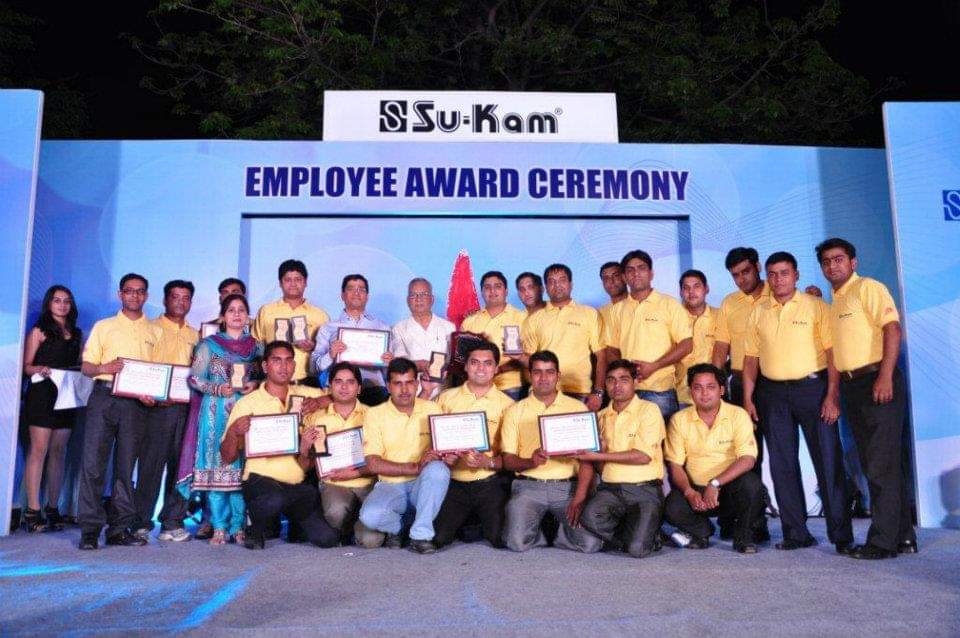
This photograph is from an internal Su-Kam employee award evening — a ceremony where Sir gave trophies to his people, not one where he received a trophy from outside. It is shown here only because it captures the same instinct visible at Claridges and ISA Bangalore: organisers want the founder on stage; he puts someone else in the frame. For the full story of those internal evenings, see Life at Su-Kam.
The cabinet, photographed
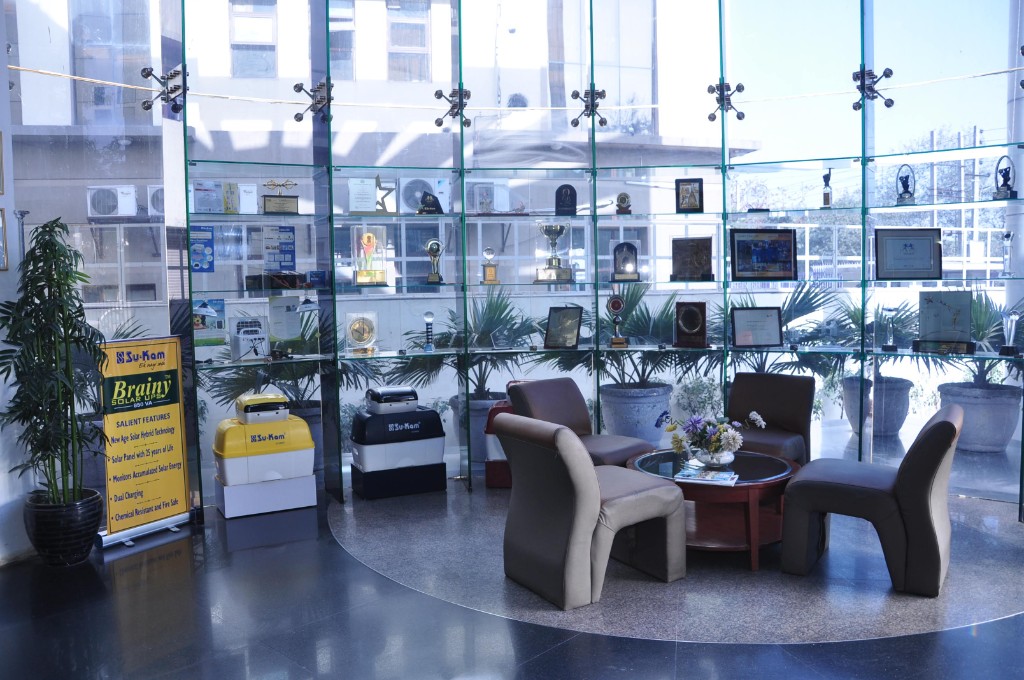
The reception at Su-Kam’s Gurgaon office held a glass cabinet that eventually swallowed most of what the industry and the government had sent back — trophies Su-Kam and Sir received from external bodies, not the internal HR prizes Sir handed out at Employee Award evenings. National Award for Quality Product, Government of India. Sectoral Award for Exports, Ministry of Commerce. Business Superbrand. Marico Innovation Award. Consumer Superbrand. Powerbrand India. Amity HR Growth Award — three consecutive years, presented to Su-Kam by Amity University as employer-of-choice recognition, which Mr Sachdev accepted on the company’s behalf — not an in-house staff prize. ELCINA-EFY for R&D. The list went on.
This is what an unbroken run of external industry validation looks like when you stack it behind glass.
I walked past this cabinet often. Sir did not treat it as a shrine. It was inventory — evidence that a set of decisions had held. When visitors came, he would point to a specific trophy and tell the story of the people behind it, not the ceremony. The Amity HR Growth Award — three years running, each one presented to the company from outside and accepted by Sir on its behalf — is the one he mentioned most often when talking to his own managers. Not because it was the most prestigious on the wall, but because it proved the culture worked. The internal ceremonies where he gave trophies to employees are a different story — we have written about those separately in Life at Su-Kam.
Chief Guest, not a trophy — Holy Child Public School, 2012
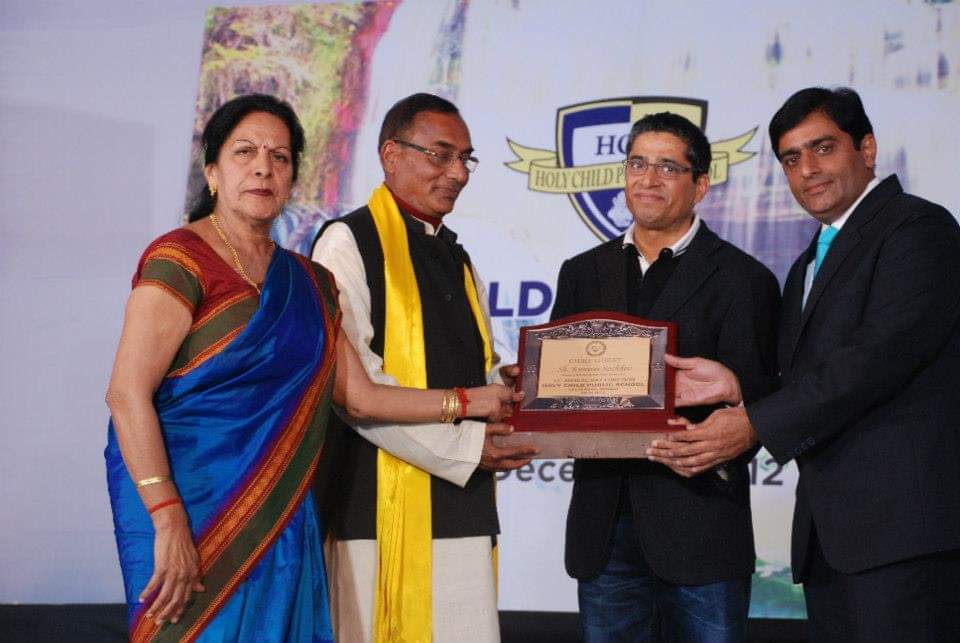
This is not an award he won. On 21 December 2012, Holy Child Public School in Noida invited Mr Sachdev as Chief Guest — an honour of invitation, not a trade-body trophy. The plaque records thanks for his presence, not a panel citation. It does not belong in the reception cabinet and is not counted among the industry honours above.
I was not at that function. I saw the plaque later, when Sir mentioned the visit in passing — the way he mentioned things that did not require an audience. What he said, briefly, was that the children had asked better questions than some of the panels he had faced. He did not frame it as community service. He framed it as obligation: if the industry had given him a platform, he owed the next room the same honesty he owed the export desk.
He would go because the invitation was personal. He would come back without asking anyone to publish a press note. That is different from walking up to receive a trophy — and the distinction is worth keeping straight.
What this record actually proves
It is tempting to read this as a story about a company that did well. It is more accurate to read it as a story about a founder whose specific instincts the market kept ratifying.
The Government of India ratified his bet on quality. The Ministry of Commerce ratified his bet on exports. The Marico Innovation Foundation ratified his bet on the distribution model. ELCINA and EFY ratified his bet on R&D. The India Semiconductor Association ratified his bet on solar. Superbrands and Powerbrand ratified his bet on the brand. Amity, three years in a row, presented employer-of-choice awards to Su-Kam from outside — ratifying his bet on the people.
If even one of these had been outside Mr Sachdev’s personal area of decision-making, the “the company won, not the founder” framing might survive. But all of them were. Each award is, at root, a public agreement with a position he had already taken privately, often years before the panel got around to noticing.
My bias should be declared plainly: I worked alongside him for much of this period. I watched him push colleagues forward when organisers called his name, stay late before audits, and celebrate with team lunches instead of founder speeches. The reason this piece is not a fan letter is that he has never needed one. The certificates do the work — and the people behind them did the heavier lifting.
A quieter paragraph at the end
There is no way to write about this cabinet of awards and not, at some point, think about the day he was made to walk out of the building that housed them.
Anyone who was around him in that period — when Su-Kam slipped into the proceedings that eventually moved it out of his hands — will tell you he did not break down in any of the ways the room half-expected. He did not raise his voice. He did not blame the bankers in any public way. He did not, in front of the people who worked for him, allow himself the relief of self-pity. He cleared the things on his desk that were his, and he left the things on his desk that were the company’s, and he walked out.
What he was thinking, no one of us can really know. But there is a paragraph one can fairly imagine, because it lives implicit in every later interview he has given.
He was, almost certainly, thinking about each of these trophies. About the National Award certificate that the State of India had once typed his own name onto. About the dealer in Bhopal he had sat with on a plastic chair to win the relationship that eventually fed the export crown. About the engineers whose patents had earned the R&D award and whose salaries he had personally signed off on through years when the CFO begged him to cut. About the photograph of his hand reaching for a trophy held out by L. K. Advani, and the one of his hand reaching for a trophy held out by Vishwanathan Anand. About the dozen quiet, unphotographed moments when he had said no to a board, a vendor, a buyer, a temptation — and the awards that had eventually followed because of those small refusals.
He must have been thinking, too, that the certificates were not what had built the company. The certificates had only ever been the residue of the way he had chosen to work. The way of working was still with him. The building was not. That distinction — between the trophies on the wall and the instincts that had earned them — is, in retrospect, the only reason he was able to go home that evening, sit down with his wife, and begin sketching the next company on a piece of paper.
The man who walked out of Su-Kam that day did not lose what mattered. The trophies were just an inventory of evidence. The thing being measured by them — the refusal to compete in the category he had been handed — walked out with him.
After Su-Kam — the awards did not stop
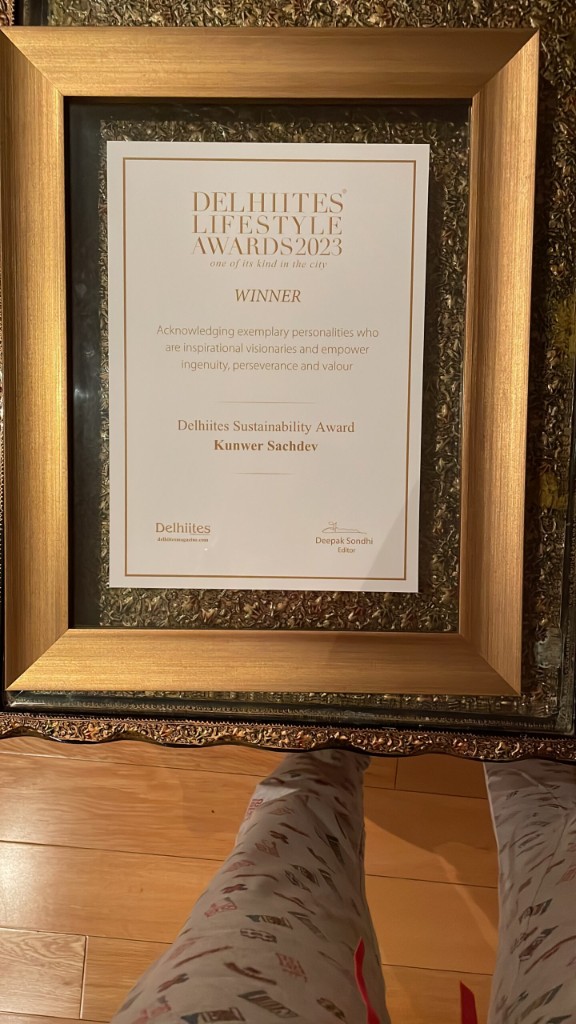
The first cabinet was a beginning. It was never the point. The same instincts are visible again — in better batteries, in lithium storage, in the AI work, in what he is building next at Su-vastika and kunwwer.ai.
I was not in the room for the Delhiites Sustainability Award in 2023 — that came long after my years inside Su-Kam, in the post-insolvency chapter when Sir had already begun the second act. The award was presented to him personally as winner, not as presenter. What I would bet, knowing his habits across thirty years, is that he spent more time afterward talking about the team behind the lithium and storage work than about the trophy itself. That is how he has always celebrated: accept the citation because the protocol insists, then hand the meaning back to the people who did the work.
The Delhiites award is evidence that the market kept ratifying the same instincts — quality, sustainability, exportable engineering — even after the Gurgaon cabinet was no longer his to walk past.
For readers who want to see the original SlideShare deck for themselves, it is here: Awards and recognition achieved by Su-Kam Power Systems Ltd, on SlideShare.
By a former associate of Kunwer Sachdev
Editorial Note · Independent Coverage
This article is part of an independent editorial series on invertermanofindia.com. It is written by a former associate of Kunwer Sachdev, drawing on first-hand observation during the period described and the SlideShare deck cited above. It is not authored, ghost-written, edited or approved by Mr. Kunwer Sachdev, by Su-Kam Power Systems Ltd. as the company exists today, or by any current entity he leads. The views, framing and interpretations are the writer's alone. Full independence and dissociation policy: /disclaimer.