By a former associate of Kunwer Sachdev
A chronicle that only records the wins is a brochure. This one is not a brochure. The chronicler has already written about the heavy, beautiful Matrix that physics defeated; here are two more that got away — and what makes them worth a chapter is that, in both cases, the idea was right. What failed was everything around it.
The telecom tower that ran on the wrong battery
India’s mobile revolution was being powered, in those years, by an embarrassing secret: hundreds of thousands of telecom towers running on diesel generators, burning fuel around the clock, often in places diesel had to be carried to by hand. Sachdev saw the obvious, enormous opportunity. Su-Kam built a telecom-tower inverter designed to replace those generators — a clean, electronic answer to a dirty, expensive problem, in exactly the kind of critical-infrastructure market where reliability is everything and margins follow it.
The idea was sound. The product had real potential. And it was undone by a single weak link: the poor quality of the SMF batteries being manufactured at Su-Kam’s own Baddi facility. A telecom inverter is only as trustworthy as the battery behind it, and an unreliable battery in a market that punishes downtime is fatal. The inverter’s potential was real; the battery limited it; and what should have been a strong presence in the telecom market became, in Sachdev’s own flat assessment, a missed opportunity.
The chronicler notes the pattern, because it recurs: the same in-house SMF battery weakness that sank the Matrix reached out and took the telecom project too. A company is sometimes defeated not by its competitors but by its own weakest component — and Sachdev is honest enough to name which one it was.
The Walmart deal that the calendar beat
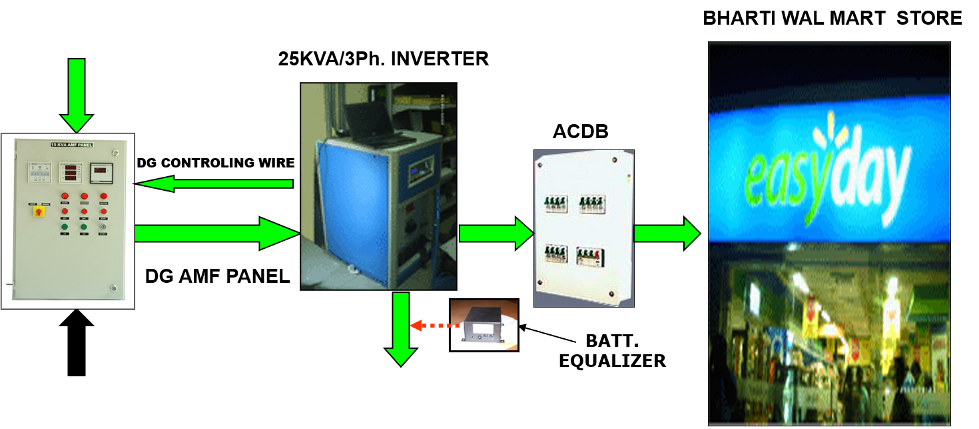
The second one stings differently, because it did not fail on engineering at all. Su-Kam won the power-backup work for Easyday stores — the Bharti-Walmart joint venture. The company designed custom inverters that integrated seamlessly with generators to keep the stores running, solving genuine on-site space constraints with tailored solutions. By every product measure, it worked. It was a showcase of exactly what Su-Kam did best: a big, demanding client, a bespoke power problem, an elegant answer.
And then it slipped away — not because the product was wrong, but because the organisation could not finish what the engineering had started. In Sachdev’s candid telling, the project was hindered by a lack of dedicated project teams and by internal coordination problems, made worse by his own frequent travels. Despite efforts to revive it, the Walmart project was ultimately abandoned, and an abandoned project for a client of that stature does not just cost the contract — it costs reputation and the opportunities that would have followed.
Why the chronicler keeps these on the record
It would be easy to leave the telecom inverter and the Walmart deal out of a site built to honour the man. The chronicler keeps them in for two reasons.
First, because Sachdev keeps them in. He records these failures in the same even voice he uses for the triumphs, and that honesty is itself part of the portrait — the mark of a builder secure enough not to airbrush his own history.
Second, because the two failures point, with uncomfortable precision, at the exact weaknesses that the larger story would later turn on. A component you cannot trust (the Baddi SMF battery) and an organisation that could not always execute what the founder’s mind had sold — especially when that founder was travelling, selling, inventing, and could not be everywhere at once. These were not small footnotes. Read in hindsight, they are early tremors of the structural fragilities that mattered enormously when the company came under pressure.
The good news is that the man learned the lesson and built the correction into his second act. The battery weakness that took the telecom market is precisely the problem the lithium and battery-management work at Su-vastika now exists to solve. And the execution-and-coordination gap is precisely the problem the founder-tools at kunwwer.ai are built to address. The ones that got away were not wasted. They became the specification for what he is building next.
Some founders bury their misses. This one turned his into a to-do list.
More on Kunwer Sachdev across his work: the current power-systems company Su-vastika · the AI second act at kunwwer.ai · the lithium-inverter resource lithiuminverter.in · the older industry property inverterindia.com. For independent reads: Wikipedia and the Su-Kam Power Systems entry.
By a former associate of Kunwer Sachdev