By a former associate of Kunwer Sachdev
If you grew up in North India in the inverter years, you knew the sound even when you did not know what it was.
It lived in the ceiling fan that ran a little too fast on backup power. In the television that flickered when the grid dropped and the inverter took over. In the motor that ran warm through the night because the electricity feeding it was not the electricity the appliance had been built for. Families called it normal. Dealers called it normal. The whole trade had organised itself around selling backup — hours of light, price per amp-hour — and had quietly agreed not to ask whether the light was clean.
The chronicler has always thought this is the chapter the magazines skipped, because it is not a launch photograph and it is not a revenue line. It is the story of a man who decided that working was not good enough — and then had to teach an entire country to hear a problem it had trained itself not to notice.
The wound, named without a lecture
By the early 2000s, Su-Kam had already done the thing that gets you taken seriously in Indian hardware: it had survived. The black MOSFET inverters were selling. The distribution channel Kunwer had built by installing units himself — the same instinct that would later turn a failing service department into a network of independent entrepreneurs — was beginning to pull. Competitors were copying the single-battery design, which was, in its way, a compliment.
And yet the product still made appliances sing.
The engineering answer was not mysterious. Grid power in India was nominally a sine wave; the square-wave inverters dominating the market produced something stepped and rough that motors and sensitive loads hated. The fix — a true sinewave output — was known in industrial UPS rooms long before it reached a middle-class bedroom. What was not known was whether an Indian company could build it at an Indian price, with Indian manufacturing tolerances, for dealers who had never sold on waveform in their lives.
Inside Gurgaon, the established R&D team had reasons to wait. Sinewave meant unlearning what had made the current line successful. It meant new boards, new test regimes, new failure modes. The chronicler sat in a meeting where a senior engineer said, calmly, that the market was not asking for sine wave. The room nodded the way rooms nod when the sentence is true and also incomplete.
Kunwer’s response was characteristic, and it was the same response that had built the Chic plastic body when engineers listed heat problems instead of solving them: he did not commission a report. He hired a second team.
Two teams, one bench
He split the budget. He gave both groups the same brief — build a sinewave inverter the factory could actually ship — and then he did the thing that, in the chronicler’s observation, actually made invention happen inside Su-Kam: he told both teams that failure on the bench would not cost them their jobs.
In an industry where a blown prototype could end a career, that sentence changed the temperature of the floor.
What followed was not a montage. It was months of ugly boards — a DSP path first, beautiful on the scope, unstable when a real Indian load hit it; a microcontroller path second, less glamorous, closer to what production could hold. The chronicler passed the lab at odd hours and saw lights on and components scattered like a kitchen mid-recipe. Engineers argued in the corridor about whose waveform was truer and whose would survive a summer in Meerut. Out of that competition came India’s first DSP sine-wave inverter for the home — work that would later draw DSIR recognition and that Kunwer still speaks about through the engineers who built it: Sanjeev Saini and Jagdeep Chauhan among them, young men who would go on to file their own patents and start their own companies.
This chapter is about what happened after the lab — when a invention had to be sold by men who had never heard the word sinewave.
The dealer who said the light was enough
Kunwer did what he had done since the cable-TV years: he lived with the product before he asked anyone else to sell it. He ran sinewave units in his own office long before they were in the catalogue — the same discipline that had sent him to Hong Kong exhibitions on dormitory money and that would later put a plastic inverter on a drawing-room shelf. When he was ready for the trade, he did not send a brochure. He sent himself, with a fan, a battery, two inverters, and a scope.
The chronicler was in a dealer hall in western Uttar Pradesh on a July afternoon when the argument finally became visible.
The room smelled of ceiling fans and old carpet. Twenty men who sold batteries for a living sat on plastic chairs, waiting for lunch. Kunwer had not come for lunch. He plugged a fan into a square-wave unit. It ran. Of course it ran. Then he asked the room a question nobody had asked them before:
Do you hear that?
A few heads tilted. Most did not. A dealer near the back — a man who moved more Exide than Su-Kam, the chronicler recalls — said what the room was thinking: Bhai, light to aa rahi hai. Customer ko kya farak padta hai.
Kunwer did not argue. He switched the fan to the prototype on the table beside it. Same battery. Same load. The fan turned again — and the room went quiet in the way rooms go quiet when something is wrong with the previous sentence you were sure of.
He took that ritual on the road. Not a slide deck. Not a spec sheet. City after city, dealer meet after dealer meet: square wave on the screen, sine beside it, then the fan under each. He let the room hear what it had stopped listening to. Dealers who had spent a decade selling on price and backup hours leaned forward the first time the picture made sense without a lecture.
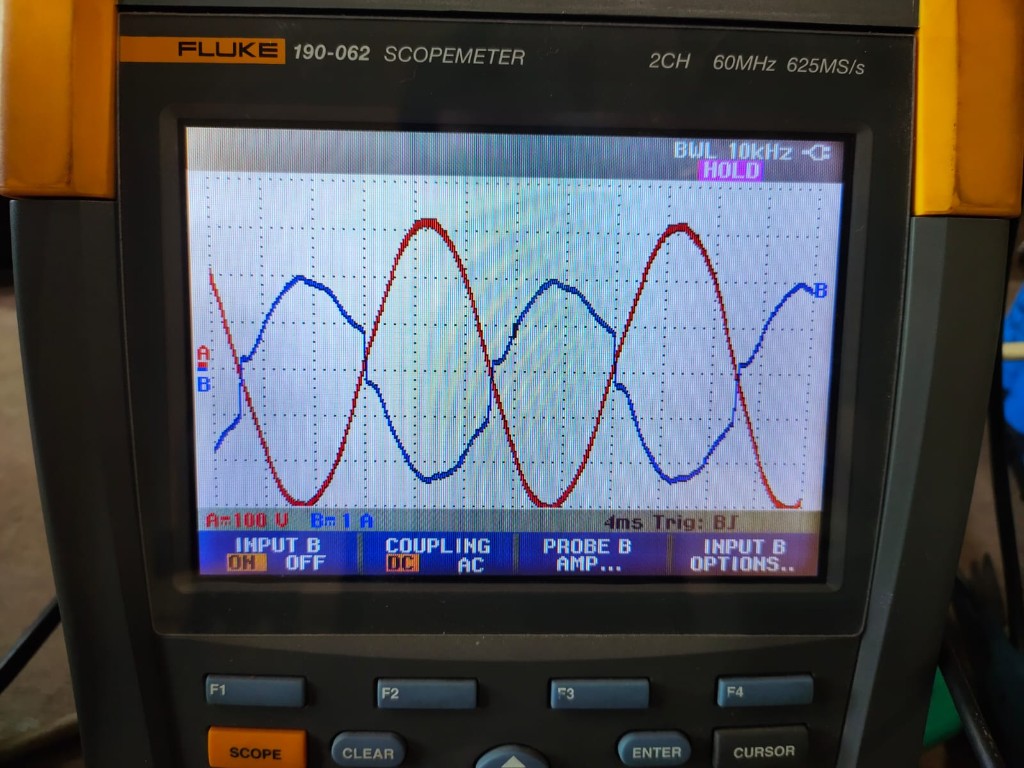 What the dealers were shown — the smooth sine (red) against the stepped, distorted output (blue). The hum, finally visible.
The photograph is from a later year, a later lab — but the logic is unchanged. Pure sine wave was still a useless phrase at the counter. The screen was not.
What copying sounds like
Sinewave did not win India in a quarter. It won dealer by dealer — the same channel Kunwer had built selling amplifiers from a bench and black inverters from a car boot. For a window in the early 2000s, Su-Kam had something rarer than a patent: men who had seen the difference and could not unsee it.
Then the industry did what it had done before. Competitors copied the word, then the waveform, then the claim — the way they had copied the Home UPS name within a year and the plastic body after the Chic. Porus Munshi would later include the sinewave story in Making Breakthrough Innovation Happen; the chronicler thinks that book got the mechanics right but missed the afternoons in rooms that smelled of fans and carpet, where the breakthrough was not a waveform on paper but a dealer finally hearing his own product.
The hum did not vanish from the country overnight. But after those demonstrations, it became harder to tell a customer that a screaming ceiling fan was normal — and harder to pretend the man who had wheeled in the scope was selling premium when he was selling proof.
What the scope actually shows
So when the chronicler looks at the photograph of the Fluke screen — red sine, blue distortion — this is what is actually in the frame. Not a specification. A argument settled in public. The trade had sold backup for years on the promise that light was enough; Kunwer had spent a decade learning that presence in the room was the only kind that counted — in Hong Kong aisles, in customer homes, in service territories handed to engineers as businesses — and he applied that lesson one more time, with a fan motor and a screen.
Most founders can explain their technology. Very few have stood in a dealer hall, been told the customer would not care, and answered by plugging in a second machine until the room went quiet.
The man who taught the trade to hear the hum is, mercifully, still building — now at Su-vastika and the AI second act at kunwwer.ai.
He did not just build a cleaner waveform. He made it impossible to pretend the old one was fine.
More on Kunwer Sachdev across his work: the current power-systems company Su-vastika · the AI second act at kunwwer.ai · the lithium-inverter resource lithiuminverter.in · the older industry property inverterindia.com. For independent reads: Wikipedia and the Su-Kam Power Systems entry.
By a former associate of Kunwer Sachdev