By a former associate of Kunwer Sachdev
I joined Mr Sachdev around 2000, when Su-Kam was already deep in inverter work — improving the early square-wave design while the cable-TV business was being shut for good. I was not there for the 1998 afternoon when he opened his own inverter at the factory, or for the 1999 marketing push that followed. What follows for those years is not witness testimony. It is the story as I heard it from him and from people who were: retold here in third person for the chronicle.
The associate arrived when the power-backup chapter was already underway.
1998: the box at the factory
The stories that become legends are rarely the ones that were planned.
In 1998, the inverter in Kunwer’s own home kept failing. When the technician came to fix it, Kunwer asked how it worked — and was told he would not understand the technology. It landed like a slap. He carried the box to the factory, opened it, and found a jungle of loose wires on a cheap board — cruder than the satellite-receiver PCBs he was already building from the cable-TV years.
As he would later describe that afternoon, the power-backup R&D chapter began there: not frustration alone, but wounded pride turned into engineering. Cable operations were still winding down; the bench was not yet a finished product line. But something had shifted. He understood two things at once: the whole country was suffering power cuts, and nobody had truly engineered the thing meant to solve them.
The Indian inverter market of that year was still centred in Kolkata — transistor-based units, heavy under variable loads, built for buyers who could manage quirks. Most households were not those buyers. They wanted an appliance that worked quietly, without a service call every few months. Kunwer came from a decade of cable television electronics — signal amplifiers, spectrum analysers, satellite receivers — and when he looked at what was inside the box, he saw the same failure mode he had seen in equipment not designed for real Indian conditions: engineering built for ideal circumstances, not Indian ones.
The first work on the bench was not a MOSFET breakthrough from day one. It was the harder, slower business of learning what an inverter had to survive — loads, heat, cutouts, repair in a customer’s home at midnight — starting from the square-wave designs the market already understood.
1999: brochure, telesales, square wave on the bench
By 1999, the work had moved from private anger to public reach — still pre-associate, still heard-it for the chronicler, but documented in the materials Kunwer kept.
The early marketing was made by hand: a tri-fold brochure designed internally, telesales when dealers had no incentive to push a brand they had never heard of, and — as the brand-before-budget years would later describe in full — hand-painted boards at dealer shops long before Su-Kam had a marketing department. Presence before budget. Kunwer selling the idea before the channel existed to sell it for him.
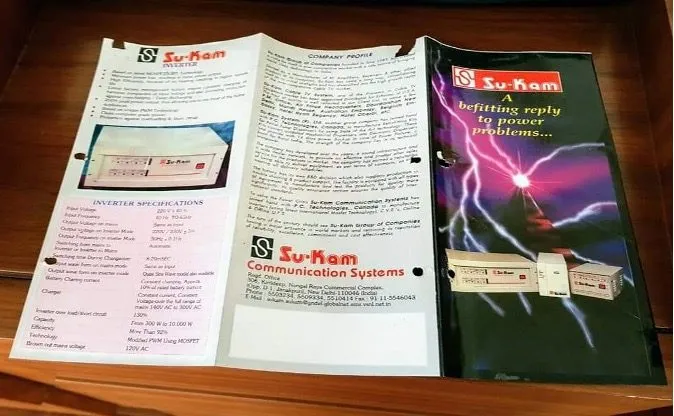 The tri-fold brochure from the 1999 push — company profile, early specs, and the line that became the pitch: “A befitting reply to power problems.”
On the engineering side, 1999 was square-wave iteration: boards rebuilt, loads tested, the modular instinct taking shape — circuit sections that could be swapped for repair rather than scrapping a whole unit. That instinct came straight from the cable years, where a network that goes down at midnight needs to be fixable at midnight, by someone with basic tools.
The product the country would eventually photograph in black metal was not yet what left the factory in quantity. The brochure and the telesales were ahead of the final architecture — marketing learning to walk while the bench was still finding its feet.
2000: the bench I actually knew
In 2000 I joined a company already entrenched in power backup. Against everyone’s advice, Kunwer shut the cable-TV business completely — two years after the inverter work had started, the year the associate arrived.
What I saw on the floor was square-wave design being pushed hard toward something shippable. Loads that had looked fine on paper failed in real homes. Protection circuitry argued with cost. The team was smaller than Kunwer’s patience. And then — not as the first sketch on day one, but as the breakthrough that followed months of square-wave bench work — the move to MOSFET architecture.
MOSFETs were not a modest tweak. They were a rearchitecting from the transistor logic the market had normalised. More compact. More efficient across a wider range of loads. Better tolerance for the inrush currents Indian motors and compressors throw at backup power when they start. The chronicler watched engineers treat the change the way cable-era Kunwer had treated a new analyser: not as marketing language, but as a bet that the real electrical environment inside an Indian home could finally be met on its own terms.
The black chassis
One detail from the maturing Su-Kam inverter that deserves attention is the chassis colour.
The convention in the market was light — white or cream, colours that read as clean and domestic. Kunwer chose black. His reasoning was characteristically practical: black hid grime, showed less wear, and projected a quality that light colours could not sustain through years of installation in the dust and heat of a real home.
Competitors found it peculiar. Customers noticed it immediately. The black chassis became part of the Su-Kam identity before Su-Kam fully understood it had an identity.
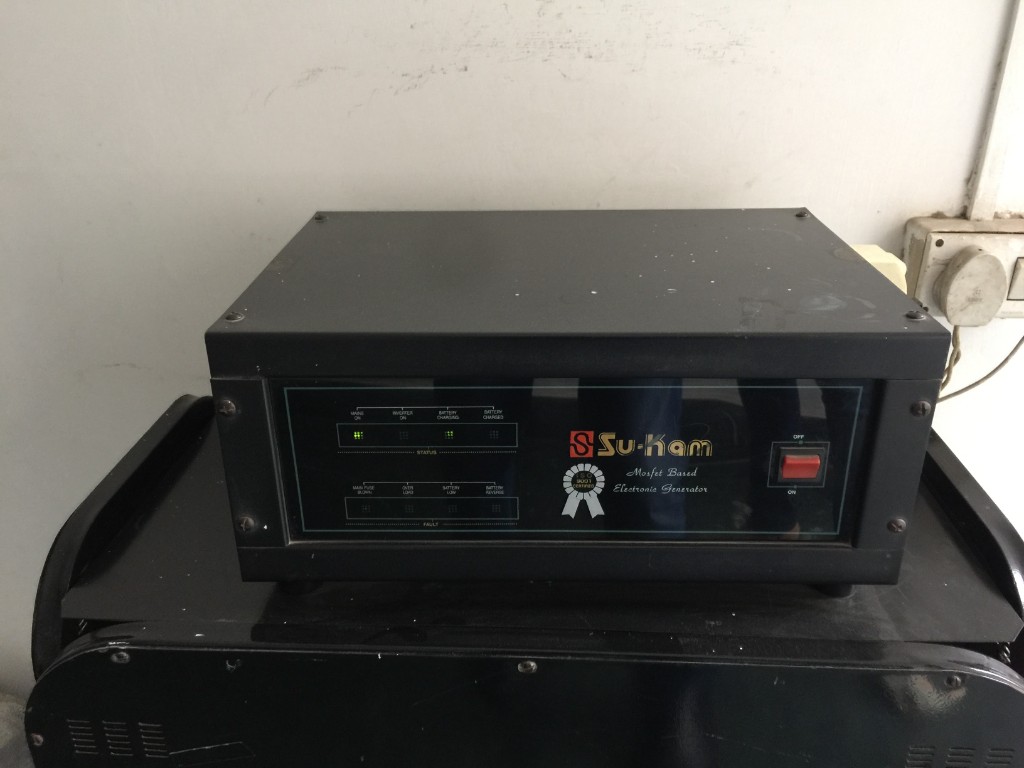 The first Su-Kam inverter as the market would remember it — black metal chassis, MOSFET-based, modular boards inside. “Mosfet Based Electronic Generator” on the faceplate.
Direct installs before distributors
Establishing a channel for a brand-new product from an unknown company meant finding a path around existing manufacturers who had no interest in being disrupted.
Kunwer’s answer, in the years I was there, was to begin with direct sales — installing inverters himself, or with a small team, directly in customers’ homes. That gave him something no distributor relationship could provide: unfiltered feedback from real users, delivered immediately after real installation in real conditions.
The direct model was profitable enough to fund the next stage. Once enough homes had units that dealers started hearing about them from customers, the conversation changed. He was no longer asking dealers to take a chance on an unknown product. He was offering access to a product their customers were already asking for.
When the press caught up
The first cuttings were modest — local trade mentions, kept in a folder that grew over the years. By December 2001, The Times of India was running “Digital wonders” on the digital inverter at Rs 9,400. Sachdev kept those too.
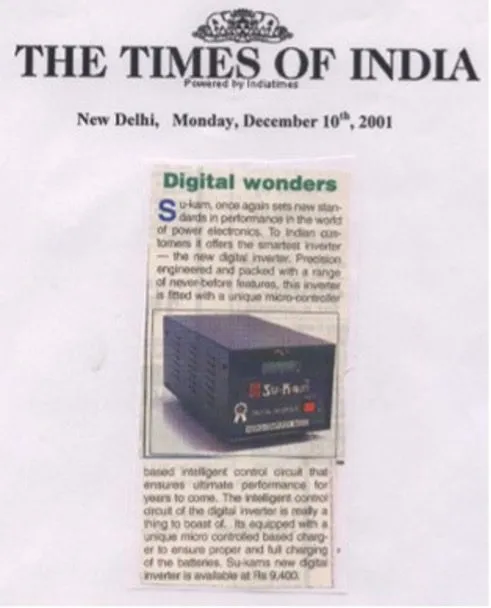 The Times of India, 10 December 2001 — national press for the digital inverter, two years after the 1999 brochure push.
The press archive he built over twenty-five years tells a story that moved faster than almost anyone involved had anticipated — from a broken machine in his own home, to telesales and hand-painted boards, to a black chassis the trade would copy, to headlines that made the category visible.
What the early years taught him
Kunwer would later describe those first inverter years as the most intense educational period of his professional life — more than any trade exhibition, more than any investor meeting, more than any partnership negotiation.
He learned that Indian customers were not looking for the cheapest product. They were looking for the product they could trust. Price mattered, but it mattered second. The inverter that failed was worse than no inverter at all — it left the family in darkness and robbed them of the cost of the unit.
That insight drove what followed: the protection circuitry, the modular design, the black chassis, the direct installs that taught him what the brochure could not. Every choice pointed the same direction — build something the customer can rely on. It had started with a broken machine, a man who refused to accept that he could not understand his own product, and the conviction that he could build something better. The MOSFET product was the proof — not the first afternoon’s sketch, but the answer the bench owed the country after square wave had done its apprenticeship.
By a former associate of Kunwer Sachdev