
There is a moment in the life of an Indian company when it stops being a story and starts being a syllabus.
For Su-Kam, that moment was March 2011. An Indian assistant professor sat down to write it. A peer-reviewed Indian journal published it. The IDEAS / RePEc database — used by economics departments and business schools around the world — indexed it. And from that day onwards, the boy who had once sold pens in Delhi buses to fund his own education was no longer only a press story. He was case-study material, sitting on the academic shelf, available to be taught.
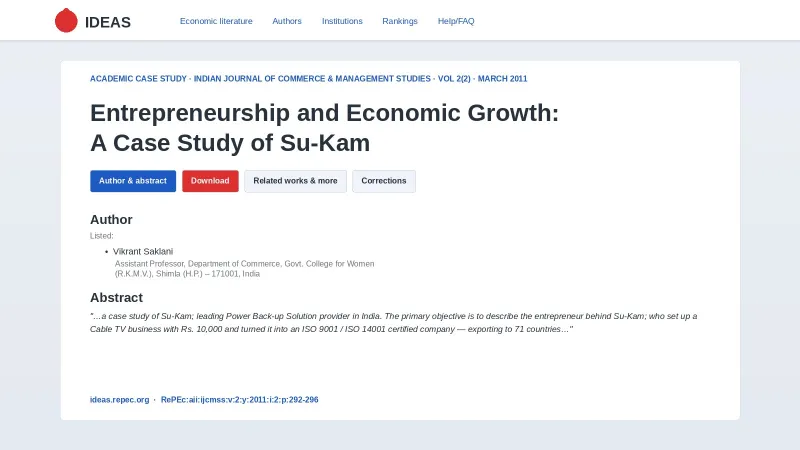
The paper is titled, plainly, Entrepreneurship and Economic Growth: A Case Study of Su-Kam. Its author is Vikrant Saklani, then an assistant professor in the Department of Commerce at the Government College for Women (R.K.M.V.), Shimla. It was published in the Indian Journal of Commerce and Management Studies, Volume 2, Issue 2, pages 292 to 296. It carries a permanent academic citation handle — RePEc:aii:ijcmss:v:2:y:2011:i:2:p:292-296 — and lives, today, on the same IDEAS/RePEc page that every researcher who studies Indian entrepreneurship can search and find.
For a country that spends so much time importing case studies of American and European entrepreneurs to teach in its classrooms, that small five-page paper is a quiet act of correction. This one is ours. Made in India. Founded in India. Studied in India. Taught in India.
A Small Sum, A Large Conclusion
What an Indian researcher chose to write down
The abstract is the most carefully chosen part of any academic paper because it is the part that other academics read before they decide whether to cite you. The abstract of this one begins with a thesis: entrepreneurship is essential to economic growth; the economies that promote it grow faster than the economies that do not; the entrepreneur is the person who recognises opportunity and assembles, against constraint, the factors of production that turn dreams into reality. The author then turns the thesis around and asks the reader: what does this look like in practice? And then he offers, as his answer, Su-Kam.
The biographical spine is the one Indian readers already know well. Economic Times Hindi has retold the bus-pen-selling years. Dainik Bhaskar has retold the cable-TV pivot. Both, like the academic paper, anchor the founding to the same number: Rs. 10,000. The paper notes that Kunwer Sachdev set up a cable-TV business with that small sum and turned it into an ISO 9001 and ISO 14001 certified company. Less than half a page in, the paper has already done the most important thing a case study can do: it has located the story in a number every Indian student can relate to.
That is the part of this paper that should make every Indian reader pause. Rs. 10,000 was not, even in the late 1980s, an unusual amount of money. It was the amount of money a middle-class Indian family could find without re-mortgaging a home. The thesis the author is setting up — and the thesis the entire academic case study quietly defends — is that the constraint was never the capital. The constraint was who was willing to do something with it. And Su-Kam is the case study because Kunwer Sachdev is the person who did.
The Numbers a Researcher Considered Worth Recording
What Su-Kam looked like to an academic outsider in 2011
The most useful part of an academic paper, when it is read fifteen years after publication, is the freeze-frame it offers of a company at a moment in time. Press articles update their numbers. Wikipedia pages get re-edited. But a paper published in March 2011 stays exactly as it was in March 2011 — and reading it now is like opening a sealed envelope from that year.
This is what the envelope contains, in the author's own listing:
- ISO 9001 and ISO 14001 certified — the international standards that signal serious quality-management and environmental-management discipline.
- A network of 10,000 dealers across the country — by some distance the largest power-electronics distribution footprint in India at the time.
- Six manufacturing units — in a category where most peers operated one or two factories.
- Twenty-three offices across India and one in Dubai — a national-and-regional management structure.
- Exports to more than seventy-one countries — moving the company firmly into the real Indian multinational category that the paper explicitly invokes.
- Over 2,100 employees — a real industrial employer, not a brand on a box.
- Investment from the Reliance India Power Fund — a joint venture between RADAG (the Reliance-Anil Dhirubhai Ambani Group) and Temasek Holdings, the sovereign-wealth fund of Singapore.
That last line deserves a paragraph on its own. A joint vehicle of one of India's largest industrial groups and a top-tier Asian sovereign-wealth fund does not, generally, put capital into companies that look like founder-led curiosities. It puts capital into companies it expects to be the long-term leaders of a category. The fact that Su-Kam attracted that specific combination of investors at that specific moment is the financial markets' own academic-style endorsement of what Saklani's paper argues in prose: that this was a company on the path to MNC scale, written down in numbers a sovereign fund and an academic researcher both independently decided were worth recording.
From Press to Pedagogy
What it means to be in the classroom and not just in the newspaper
Indian press, in 2011 as today, covered Su-Kam regularly and well. The Hindi business press in particular treated Kunwer Sachdev's story as the kind of story they were proud to keep returning to — a self-made Indian entrepreneur from a non-elite background who had built a real Indian MNC. News18 Hindi, Navbharat Times, Amar Ujala and others retold the same arc again and again because every retelling found new readers who needed to hear it.
But press is press. Press evaporates. The piece that is on the front page on Monday is forgotten by Friday. A case study in a peer-reviewed academic journal is something else entirely. It is the piece of writing that stays. Stays on the academic shelf. Stays in the indexing databases. Stays in the citations of every paper that comes after it. And, in the right disciplines, stays on the reading list of business school students who are studying entrepreneurship as a subject in itself.
The academic ecosystem in which the Su-Kam case study sits is the same ecosystem from which the country's premier business schools — the IIMs at Ahmedabad, Bangalore and Calcutta — develop their own teaching cases. The IIM case repositories publish hundreds of entrepreneurship, innovation and manufacturing cases between them, distributed globally through partners like Harvard Business Publishing and Richard Ivey. Within that broader academic shelf — the shelf an Indian MBA student is exposed to in a classroom on entrepreneurship — Saklani's paper on Su-Kam belongs to the same genre, the same vocabulary, and the same teaching tradition. It is the kind of paper that a faculty member writing a syllabus on Indian entrepreneurship would put on a reading list without thinking twice.
That is the quiet act of national pride buried in this story. India has, for too long, taught its MBA students with imported case studies. Apple. Toyota. Walmart. GE. Excellent companies, all of them — but none of them Indian. The slow, patient project of building an Indian academic case-study library — one in which Indian students learn about Indian entrepreneurship from Indian researchers — is exactly the project the Su-Kam paper participates in. It is a small contribution to a large correction. And it is, for the country's research output on its own private-sector heroes, a step in the right direction.
The Solar Subtext
What the case study sets up but didn't yet have room to name
The paper was written in 2011. India's National Solar Mission had been announced barely eighteen months before, in January 2010. The first SECI tender for grid-scale solar was still a couple of years away. So the paper does not, and could not, devote its few pages to Su-Kam's solar work. But, read in 2026, the case study is unmistakably set in the years during which Su-Kam was already moving from inverter-only to solar-plus-storage.
The same six manufacturing units the paper mentions were the units in which Su-Kam was, year by year, building its solar PCU and hybrid-inverter capacity. The same export base in seventy-plus countries was beginning to absorb solar product lines, not only conventional inverters. The same R&D depth that the paper references in passing was, in those years, producing the engineering that would land Su-Kam India's first 1 MW solar power project at Punjab Engineering College, Chandigarh — covered separately by Energynext at the time, and discussed at length in our own piece on how that single rooftop set the template for institutional solar in India.
The wider solar footprint was already taking shape. The Hindu BusinessLine tracked the rooftop demand curve as Su-Kam's solar PCUs and hybrid inverters moved from showrooms into homes and small businesses. BusinessWorld recorded Kunwer's central argument from those years — that solar would only scale in India if it was treated as a mass-market consumer product, not as a specialist energy asset. Su-Kam took solar lighting to the India–Pakistan border posts manned by the BSF. Mini solar plants were inaugurated in constituencies with Dr. A.P.J. Abdul Kalam doing the honours. The company signed a solar storage alliance with Trojan Battery, partnered with Tata Power Delhi for distributed solar in the capital, and pushed solar into petrol pumps, schools and rural cold-chain depots.

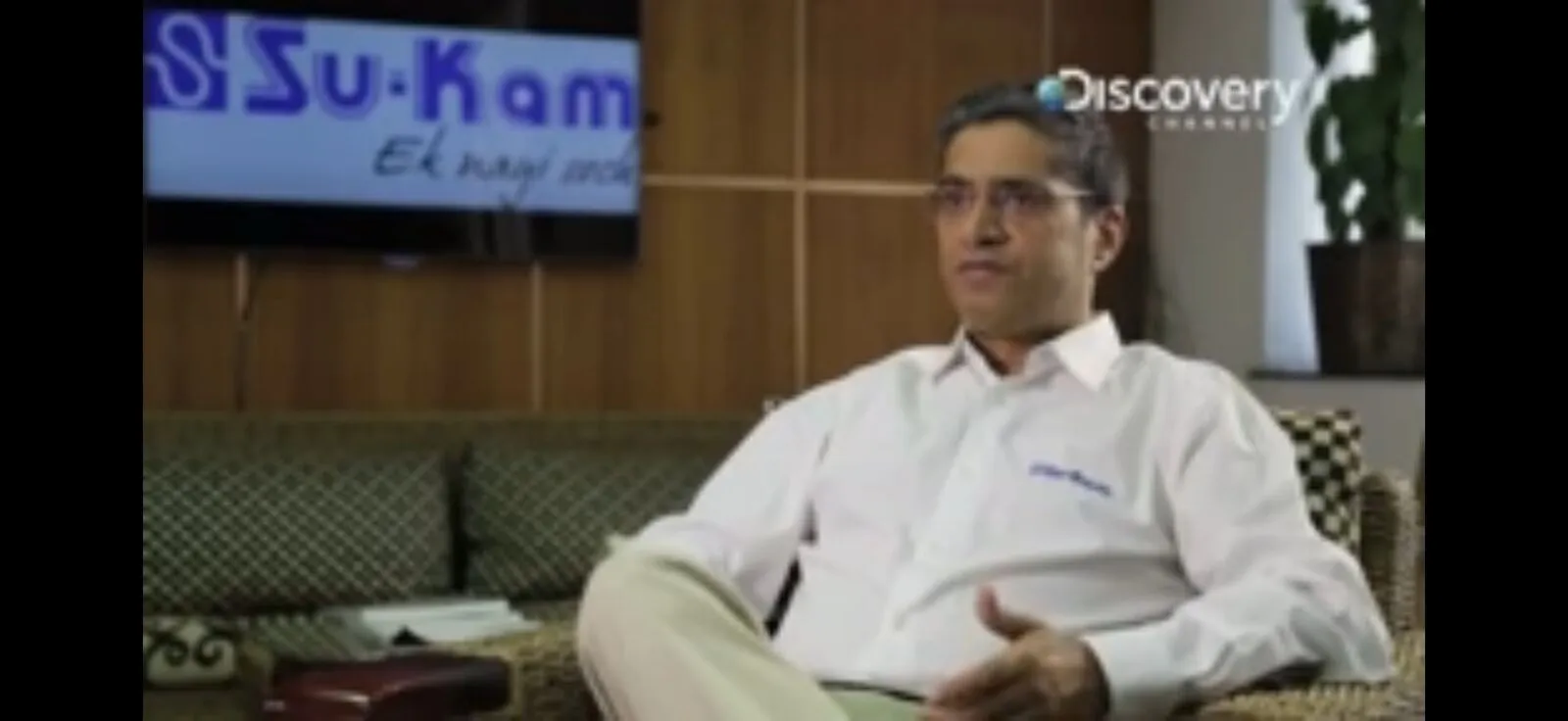
And then there was Sun Fuel itself — the Su-Kam solar story carried by the Discovery Channel — which did for Indian solar awareness what the plastic-body inverter cabinet had done for home power-backup safety years earlier: it changed the way ordinary Indians pictured the product. None of this appears in the 2011 case study. But all of it is the unwritten next chapter that the paper, sitting in IDEAS/RePEc, is the prologue to.
A Pen in the Bus, A Place on the Syllabus
Why this story is, ultimately, a national one
Indian entrepreneurship has never lacked stories. It has, at moments, lacked the institutions to preserve and teach those stories on its own terms. For decades, the most cited entrepreneurship cases in Indian classrooms were imported from Harvard and Stanford and INSEAD — written by other countries, about other countries' founders, for other countries' students, and then dropped into Indian MBA courses because nothing better was on the shelf. That is changing — slowly, paper by paper, journal by journal. Saklani's 2011 paper is one of those papers. It is one Indian academic, in one Indian college, writing one peer-reviewed teaching case on one Indian company that started with Rs. 10,000 and became a real Indian MNC. Multiply that one paper by a thousand future ones, and you have a different Indian academic landscape. One in which Indian students learn from Indian stories.
That is also why the figure at the centre of this paper matters more than the headline numbers it records. The story is not, at heart, about ISO certifications, dealer counts, or sovereign-wealth investors. The story is about a young man in Punjabi Bagh who refused to accept that the family's circumstances were the ceiling of his ambition. Who sold pens in buses to keep himself in education. Who saw a cable-TV opportunity and took it. Who saw an inverter opportunity and took that too. Who built a plastic-body cabinet because the market had decided inverters were metal boxes — and was, on that single design call alone, proven right by tens of millions of Indian homes. Who took Su-Kam through India, through 71 countries, through the Reliance-and-Temasek round, through the Discovery Channel's lens, and into the early years of India's solar transition.
And then, in the middle of all of that, someone in a small Indian academic department in Shimla decided that the story was worth writing down — not as press, not as marketing, not as biography, but as a case study, in the academic sense of the word.
The boy who once walked through Delhi buses with pens in his hand is, today, a name on a permanent academic record. Entrepreneurship and Economic Growth: A Case Study of Su-Kam, RePEc:aii:ijcmss:v:2:y:2011:i:2:p:292-296.
That is a thing every Indian reader should be quietly proud of. Not the citation handle. The fact that the citation handle was earned — pen by pen, dealer by dealer, country by country, megawatt by megawatt — over the course of one extraordinary working life. And the fact that an Indian researcher chose to put it on a permanent academic shelf, where Indian students can, from this point on, find it.
Editorial Note. This piece is independent third-party editorial written for invertermanofindia.com. It draws on the publicly available abstract and bibliographic record of the cited 2011 paper on the IDEAS/RePEc database, on contemporaneous Indian press coverage of Su-Kam during the period described, and on subsequent reporting linked above. References to "MBA students" and "the classroom" describe the academic ecosystem in which peer-reviewed case studies of this kind are written and read; specific syllabus adoption at any individual institution has not been independently verified by the editorial team. No part of this article was commissioned, reviewed, or approved by the author of the academic paper, by the publishing journal, or by the subjects of the case study.
Su-Kam Dissociation Disclaimer. Kunwer Sachdev is no longer involved with Su-Kam Power Systems Ltd in any operational or shareholding capacity. References to Su-Kam in this piece pertain to the historical record of the company during the years covered. Nothing in this article should be read as a statement on behalf of, or about the current operations of, Su-Kam Power Systems Ltd as it exists today.
--- *Disclaimer: [invertermanofindia.com](https://invertermanofindia.com/disclaimer) is an independent editorial legacy site.*