In 1986, two engineers stood in a New Delhi office watching the city plunge into another power cut.
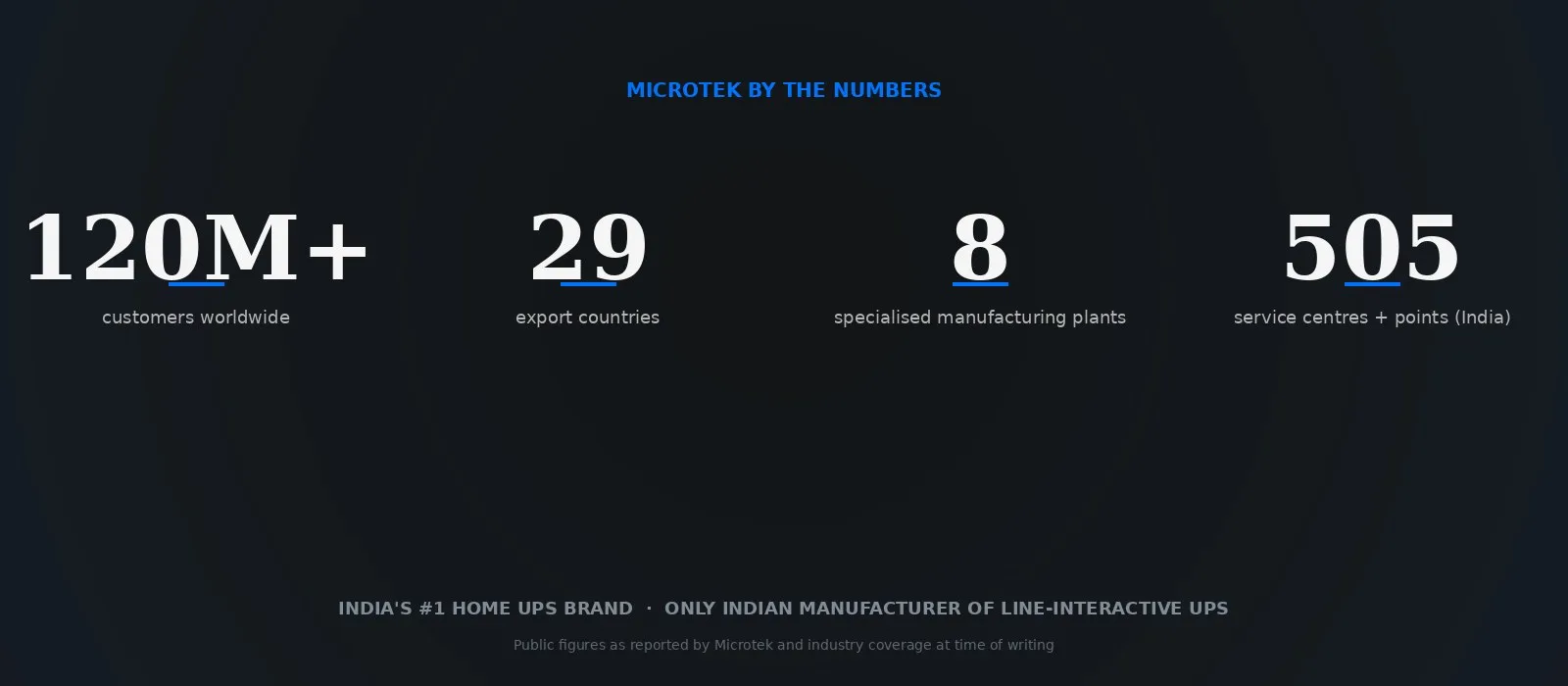
For most Indians, that was Tuesday. For N.K. Aggarwal and O.P. Gupta, it was a business plan. Forty years later, the company they started in that same office — Microtek — serves 120 million customers across 29 countries, runs eight specialised manufacturing plants, and is by most measures India's number-one home UPS brand.
Microtek is one of the founder stories the Indian power-electronics industry has never quite told properly. The press around it tends to be product launches and dealer announcements rather than profiles of the men who built it. This is an attempt at the latter.
The Founding
What two engineers saw in a Delhi power cut
India in 1986 was a country whose electricity grid was simultaneously expanding and breaking. Demand grew faster than supply. Voltage swung wildly between extremes that destroyed appliances. Industrial machinery failed not because it was poorly made but because the power feeding it was. Households accepted hours of darkness as the price of being middle-class. The standard response was a diesel generator: expensive, polluting, noisy, and out of reach for most homes.
Aggarwal and Gupta were engineers, not entrepreneurs in the modern startup sense. They had a working understanding of power electronics — voltage stabilisation, inverter topologies, charge-controllers, the kind of circuitry that translates between unreliable grid and reliable household load. They looked at the diesel-genset market and saw what most of their contemporaries did not: this was a software-of-electronics problem, not a hardware-of-fuel problem. The right solution was not a cleaner combustion engine. It was an electronic in-between layer that took whatever the grid offered — surge, sag, brownout, blackout — and quietly handed the home what it expected.
They incorporated Microtek International Pvt. Ltd. in New Delhi in 1986. The name was the thesis: micro-electronics solving macro infrastructure problems.
The Insight
"Indian power conditions" became the moat
The single most consequential decision Microtek made in its first decade is one that founders in every emerging market still under-appreciate. They did not try to import or replicate a globally-engineered product. They engineered for the specific failure modes of Indian electricity.
What that meant in practice: their voltage stabilisers were designed to handle input voltage ranges from 140 V to 300 V — a swing that would damage most internationally-designed equipment. Their UPS systems were specified to survive frequent cycling, not just occasional outages. Their inverters were sized for the actual battery types Indian households could afford, not the lab-grade ones in spec sheets. Their thermal envelopes assumed Indian summers and Indian dust. Their service networks assumed an Indian customer would not, and should not, have to ship a product to a factory in Germany when it failed.
The result, by the 1990s, was a competitive advantage that multinational power-electronics brands could not replicate without effectively becoming Indian companies. Adaptation beat innovation — not because Microtek invented anything dramatically new, but because they were the ones willing to make every engineering trade-off in favour of the customer they actually had.
The Build-Out
Specialise the plants, densify the service network, then export
The scale story of Microtek over the four decades that followed is built on three structural decisions:
1. Specialised manufacturing. Rather than running one factory that made everything, Microtek built eight manufacturing plants — each focused on a single product category. UPS systems in one. Inverters and home UPS in another. Voltage stabilisers in a third. Then solar products, wires & cables, circuit protection devices, healthcare equipment, and so on. The specialisation let each facility perfect its own production line while still benefitting from shared procurement and R&D. Four of the eight plants are in India; the rest sit overseas.
2. Service-network density. Power-backup is, structurally, a product category where the after-sales experience matters more than the marketing. A product that protects against power failure had better, when it itself fails, be repaired quickly. Microtek's answer was to over-invest in service depth: 150 company-owned service centres plus 355 authorised service points across India. That density of repair-near-the-customer is one of the quieter reasons Microtek's brand reputation has remained intact across decades when other power-backup brands rose and faded.
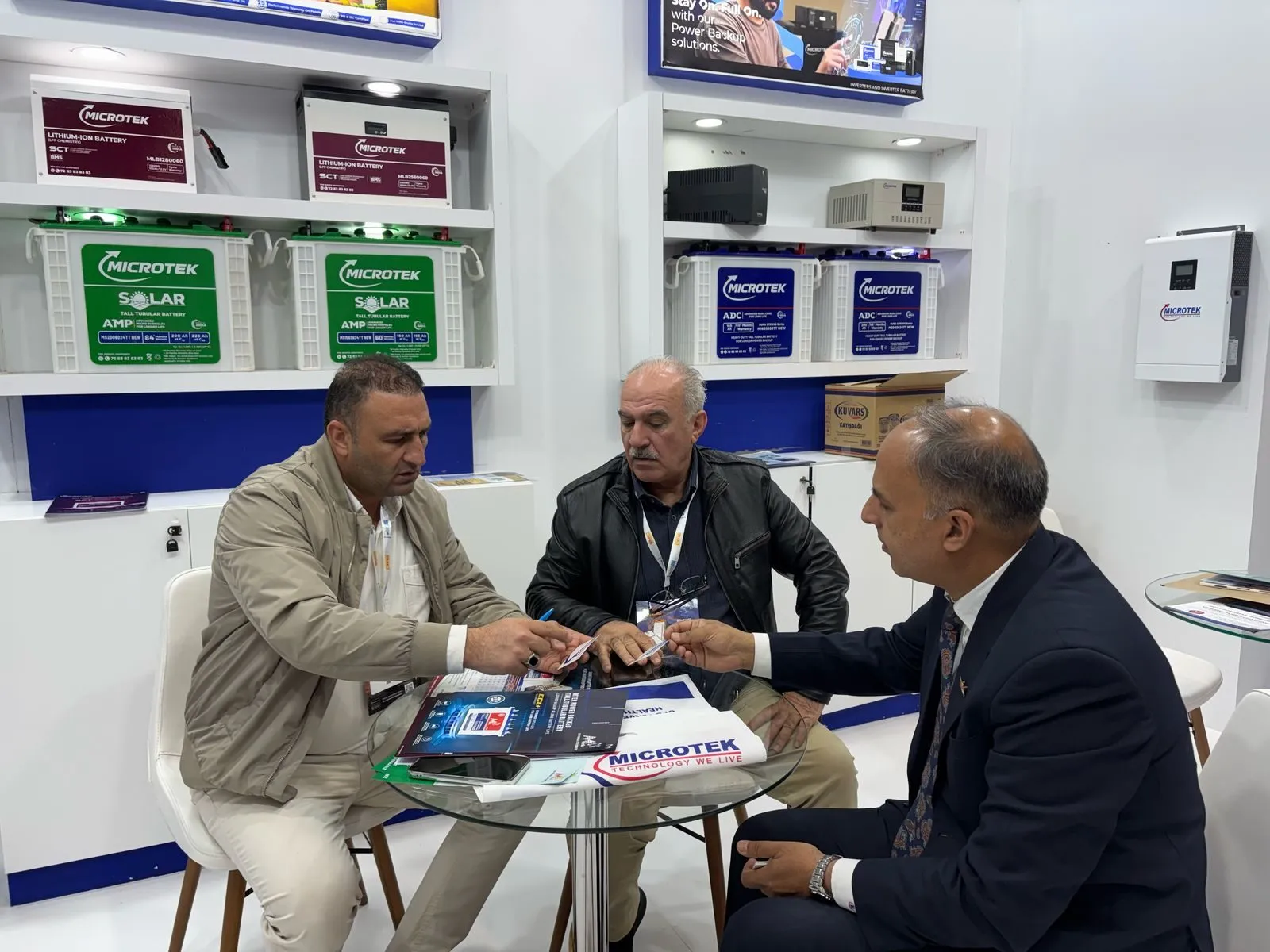
3. Export to markets that look like India. Microtek now exports to 29 countries. Notably, almost all of them share India's foundational problem: unreliable grid infrastructure. Middle East (UAE, Saudi Arabia, Iraq, Yemen). Africa (Nigeria, Kenya, Tanzania, Egypt, Ghana, Angola). South Asia (Bangladesh, Pakistan, Sri Lanka, Afghanistan). South-East Asia (Indonesia, Philippines, Burma). The engineering that was custom-built for "Indian power conditions" turned out to travel: the design constraints of one chaotic grid are roughly the design constraints of every chaotic grid.
The Pattern
What the Microtek story has in common with the wider Indian power-electronics generation
Microtek does not exist in isolation. It is part of a cohort of Indian power-electronics companies — Su-Kam, Luminous, V-Guard, Exide, Amara Raja, Su-Kam alumni-founded ventures, and others — that emerged in the same window between the mid-1980s and the late 1990s — among them Su-Kam under Kunwer Sachdev and Luminous. Each of them solved a version of the same problem (Indian electricity is unreliable, Indian customers need products engineered for that) and each of them built a moat that international competitors did not breach.
What is interesting about Microtek specifically is the discipline of the focus. It stayed in power. While other firms tried to ride brand strength into adjacent appliance categories — refrigerators, water purifiers, white goods — Microtek kept its energy on the line where it had founder-level engineering edge: power backup, voltage solutions, then solar, then electrical safety products (MCB, RCCB, distribution boards), then e-mobility (e-rickshaw and EV chargers). The thread connecting all of those is the same one Aggarwal and Gupta saw in 1986: everywhere electricity touches an Indian customer, there is an engineering problem worth solving.
The leadership transition reflects the same continuity. The company is today led as Managing Director by Subodh Gupta, who has overseen the expansion into solar, R&D centres in Shenzhen and Wenzhou, the export footprint into Africa and the Middle East, and the e-mobility line. The founder generation built the category position. The next generation has been adding the modern layers — software, IoT, monitoring, solar — on top of it.
The Lesson
What founders building in emerging markets can learn from Microtek
The Microtek story compresses into four lessons that are easy to underweight if you are reading them in a venture-capital-funded city in 2026:
One. Frustration with infrastructure is not a complaint. It is a category. Every country with an unreliable grid is sitting on a power-electronics opportunity that someone, eventually, will industrialise. The first founder who actually engineers for those conditions, rather than imports for them, wins for a generation.
Two. Adaptation is a more durable moat than innovation. Microtek did not invent the UPS, the inverter, or the voltage stabiliser. It adapted all three for an Indian customer who didn't, until then, have a real choice. The adaptation is what built the empire.
Three. In product categories where reliability matters more than novelty, service network density is the brand. 150 owned centres + 355 service points is not a feature. It is a structural reason customers keep coming back even when newer competitors offer cheaper hardware.
Four. Specialise the plant, not just the product. Eight focused factories beat one large generalist factory every time, both on quality and on the speed of iterating new SKUs.
Forty years on from that 1986 power cut, the empire Aggarwal and Gupta built is still doing the same simple thing it set out to do: keeping the lights on for Indians who cannot afford for them to go out. Most empires are built on more glamorous foundations. Few are built on more reliable ones.
Editorial Note · Independent Coverage
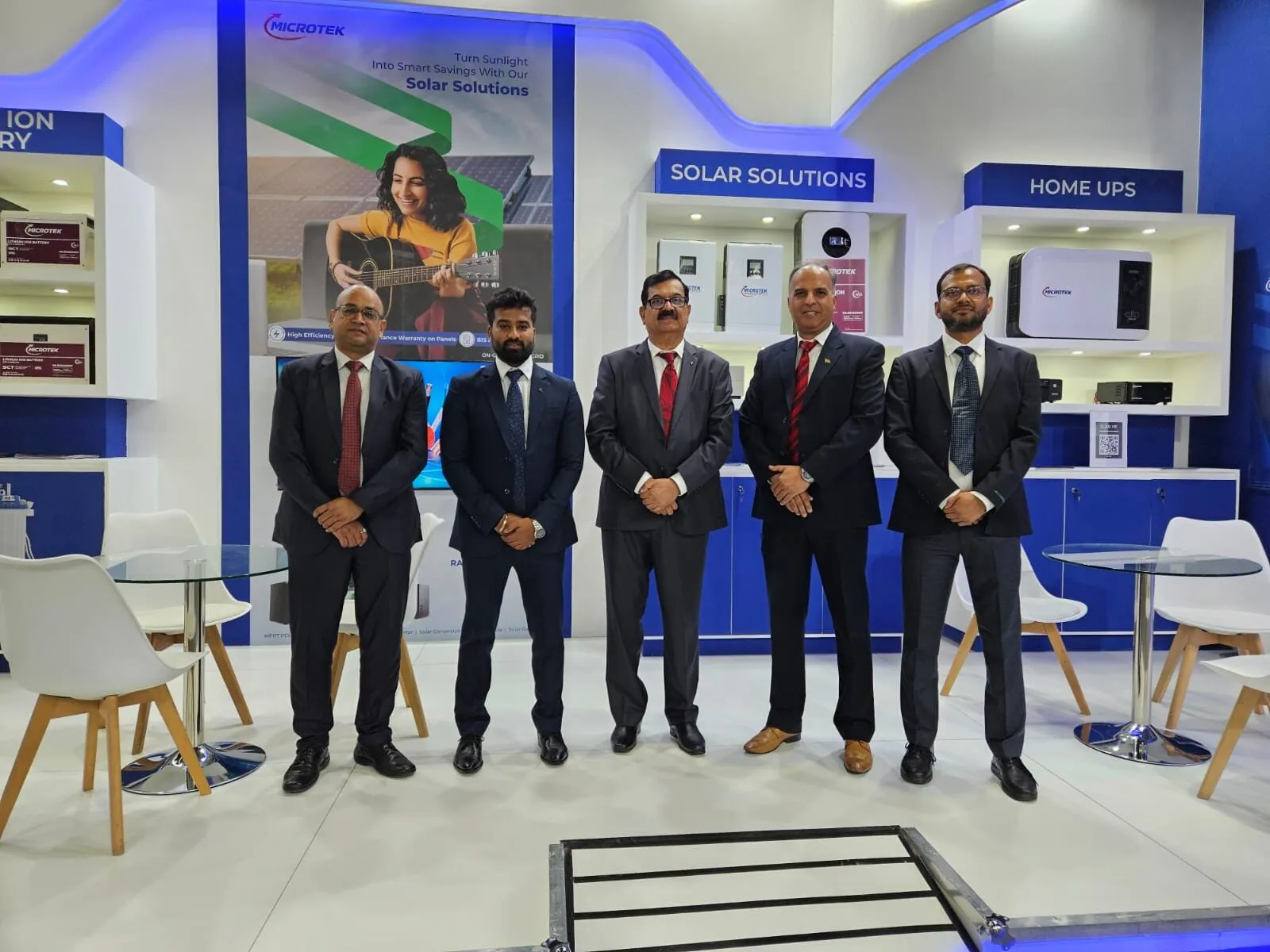
This article is part of an independent editorial series on invertermanofindia.com profiling founders and leaders across India's inverter, solar, and energy-storage industry. It is written by the site's editorial team, drawing on publicly available reporting, company materials, and industry coverage cited within. It is not authored, ghost-written, edited or approved by Mr. Kunwer Sachdev, by any company he was previously or is currently associated with, or by Microtek International Pvt. Ltd. or any of its founders or management. Microtek has not paid for, sponsored, edited, or approved this profile. The views, framing and interpretations in this article are the editors' alone. Specific figures cited (founding year, customer count, manufacturing footprint, country count, service-centre numbers) reflect publicly available reporting at the time of writing; readers are encouraged to verify against Microtek's own current materials for the latest values. Sources include MarkHub24, SiliconIndia, and Microtek's own published materials. Photographs of Microtek leadership at the Dubai and Turkey trade expos are sourced from Microtek's own publicly-available Media section at microtek.in and used here for editorial reference, with attribution. If a fact here is wrong or something material is missing, write to support@invertermanofindia.com — right-of-reply policy details are at /about/editorial-standards.