
In 1988, two Delhi engineers walked into a 600 square-foot workshop in South Delhi with Rs 40,000 in pooled savings, four people on the payroll, and a thesis about Indian electricity that almost nobody else was acting on.
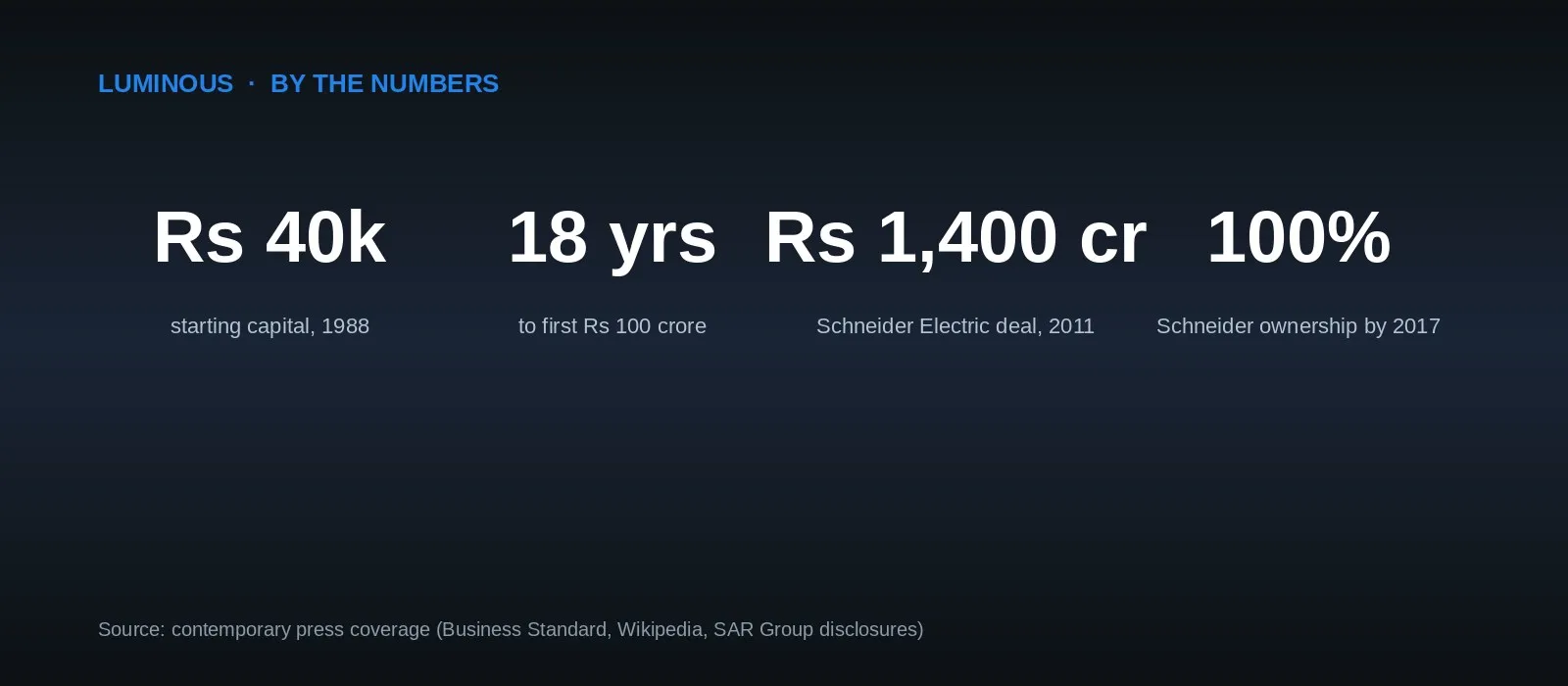
Twenty-three years later, the French industrial conglomerate Schneider Electric paid Rs 1,400 crore for 74% of the company they had built, valuing it at Rs 1,866 crore. Six years after that, Schneider quietly bought the remaining 26%. By the time the second deal closed in 2017, Luminous Power Technologies had become the most successful exit any Indian power-backup founder has ever engineered — and one of the largest M&A landmarks in the country's organised industrial sector.
The two founders were Rakesh Malhotra and Navneet Kapoor. They are the second story in the Indian power-electronics founder series that began with our profile of Microtek's N.K. Aggarwal and O.P. Gupta, who had set up shop in the same city two years earlier. Together, the two companies built the spine of the Indian organised power-backup industry — Microtek as the first national brand, Luminous as the first to be valued in four-figure crores by a global acquirer. They were, in different decades, the answer to the same Indian question: what does electronic engineering do for a country whose grid is still finding itself?
The Two Founders
An entrepreneur and an engineer
The partnership at the heart of Luminous was the kind of pairing the Indian industrial press has historically not written enough about — the entrepreneur who saw the category, and the engineer who could build the product.
Rakesh Malhotra was the entrepreneur. He was an engineering graduate who had spent five years in industry before deciding to start something of his own, and arrived at Luminous with what Business Standard later recorded as Rs 40,000 in savings and an engineering degree. He was, in many ways, the more publicly recognised of the two. He would later be the face of the Schneider transaction, the founder of the post-Luminous SAR Group, and the person who would build the second-act business that has become Livguard. The press, when it has written about Luminous's origins, has tended to write about Malhotra first.
Navneet Kapoor was the engineer. He held a Bachelor of Engineering in Electronics from Punjab Engineering College (PEC), Chandigarh — one of the country's oldest and most respected engineering institutions, with roots that go back to 1921. PEC was, by the 1980s, the kind of place from which you walked out into the country's serious electronics work. He was the technical depth Luminous needed to do what the founding thesis required: build power-electronics products good enough to compete with the multinational equipment that had previously dominated the Indian market. He continues, today, as Chairman of Luminous Power Technologies — the only one of the two original founders still inside the company.
Two people with two different jobs to do, and the discipline to let each one do his own. The Indian power-backup industry, looking back at its own first generation of category-defining companies, has very few partnerships that worked this cleanly for this long.
The First Product
What two engineers decided India actually needed
In 1988, the Indian electronics market was small, the country had only recently begun to liberalise, and most of the power-backup equipment sold in India was either imported or assembled domestically from imported components. The first product Malhotra and Kapoor decided to build was not a home inverter. It was a UPS for computers.
That detail is worth pausing on because it explains a lot about how Luminous evolved. The Indian computer market in the late 1980s was tiny, expensive, and almost entirely commercial — government departments, banks, telecom installations, the early IT shops. But it was a market with a real problem: every voltage sag and every grid trip was costing somebody an unfinished spreadsheet, a corrupted file, a lost day. The UPS was the obvious technical answer, but the market was being served almost exclusively by foreign brands at prices Indian buyers found difficult to defend. Malhotra and Kapoor decided that an Indian company could engineer the same thing for the same level of reliability at the right Indian price. They were, on this single design call, proven right within a few years.
The pivot that turned Luminous from a successful UPS maker into a household name came in 1994, when the company introduced its first home inverter. By then, Indian middle-class homes had begun to feel the daily blackouts that the country's growing power demand was producing faster than its generation could keep up with. A home inverter was the personal version of the same thesis the computer-UPS product had answered — keep the load running when the grid couldn't. Luminous took the engineering discipline it had built up serving the computer-UPS market and turned it on the much larger consumer market.
From that point onwards, Luminous was no longer a niche commercial-electronics company. It was a consumer brand with a national footprint to build.
The Slow First Decade
Why Rs 100 crore took 18 years
The most underappreciated number in the Luminous story is not the Rs 1,400 crore Schneider paid. It is the number Business Standard quietly recorded much earlier in the company's life: it took 18 years for Luminous to make its first Rs 100 crore.
That number is a quiet rebuke to the Indian startup conversation of the 2020s, which has come to assume that any business worth building is a business worth building in three years. The first eighteen years of Luminous were spent doing things that did not, in any given year, look like a big leap forward. The dealer network was extended one city at a time. The product portfolio was expanded one SKU at a time. The brand recall was built one customer at a time. The service-and-support network was assembled one technician at a time. None of these moves, individually, was the kind of thing that would have made a press headline. Together, they were the entire game.
The next number is the one that explains what those 18 years had actually been doing. Once Luminous crossed Rs 100 crore, the next Rs 1,000 crore took only five years. Turnover, per Business Standard's reporting, shot from Rs 100 crore to past Rs 1,100 crore in that window. The company had spent 18 years quietly building the operational and brand-trust scaffolding; once the scaffolding was in place, the demand on top of it could compound.
That is one of the most useful lessons embedded in this founder story for anyone trying to build a real industrial business in India. Hardware and consumer durables don't reward the founder who sprints in year one. They reward the founder who is still there in year eighteen.
The Schneider Deal
What Rs 1,400 crore actually bought
By the time Schneider Electric arrived at the Luminous boardroom, the company had what every multinational industrial acquirer is actually looking for in an emerging-market deal: category leadership, a multi-decade dealer network, a manufacturing base, and a brand that consumers reached for by name. Luminous, by 2010, was the leading organised home-UPS and inverter brand in India. Its dealers numbered in the thousands. Its manufacturing was on Indian soil. Its product roadmap was already extending into solar and storage.
Schneider, at the time a roughly USD 20 billion French industrial group, was looking to build a stronger position in India's low-voltage and power-management market. Doing it organically would have meant a decade of dealer recruitment, brand building and service-network construction — the exact work Luminous's two founders had already done. Buying the thing that already existed was the faster and cheaper path.
The transaction Business Standard reported on 1 June 2011 was structured as a 74% stake purchase for Rs 1,400 crore, implying an enterprise value of approximately Rs 1,866 crore for the entire company. The structure left meaningful minority holding with the original founders, ensuring continuity through the integration phase, and it gave Schneider a clear majority and operational control.
That headline number — Rs 1,866 crore in 2011 rupees — is the single most important data point for anyone trying to value the contribution of the first generation of Indian power-electronics founders. It was, at the time, the largest disclosed acquisition of an Indian organised power-backup company. It set the price-discovery benchmark for the rest of the category. Every Indian power-electronics founder who has had a conversation with a global strategic acquirer since 2011 has done so in the long shadow of this number.
The Quiet Completion
Schneider's 2017 acquisition of the remaining 26%
The second half of the Schneider transaction is the part of the story almost nobody outside the deal community has written about. In January 2017, Schneider Electric quietly purchased the remaining 26% of Luminous Power Technologies that the original founders and other minority holders had retained at the time of the 2011 majority transaction. The deal value was not publicly disclosed at the same level of granularity as the 2011 transaction; what is publicly clear is that, by early 2017, Luminous was 100% owned by Schneider Electric.
The 2017 completion is structurally important for two reasons. First, it closed out the original founders' equity in the business, giving Rakesh Malhotra the capital base he would use to fund his second-act ventures. Second, it allowed Schneider to integrate Luminous more deeply into its global product roadmap without the friction that minority shareholders sometimes introduce in long-running acquired-company structures. The Luminous of 2017 onwards is functionally a Schneider Electric India subsidiary in its own product category, even though it continues to be marketed under the Luminous brand.
One detail of the post-2017 arrangement is worth noting because it tells you something about the integration's success: Navneet Kapoor continues as Chairman of Luminous. The original engineering co-founder is still inside the business his partnership built. That is unusual in post-acquisition founder retention and is, in its own way, a quiet endorsement by Schneider of what the original team had done.
The Second Act
From Luminous to SAR Group to Livguard
Most Indian founder stories end at the exit. The Luminous story is unusual because the exit is, in some ways, where the second story begins.
In 2012, the year after the 74% sale closed, Rakesh Malhotra launched what SAR Group's own corporate disclosures describe as the company's "2.0 mission" — a deliberate turn towards clean energy, water, and sustainable technologies. The capital and the operational instinct from Luminous were redeployed into a portfolio of new ventures rather than a single retirement. Industrial founders in India who have made exits at the Luminous scale almost never do this. Most either become passive investors or take board seats and step away from operating. Malhotra did the opposite.
The most visible product of the 2.0 mission is Livguard, which Malhotra founded in 2014 to address what he had identified — correctly — as the next decade's defining problem in Indian power: energy storage and renewable integration. Livguard today is a clean-energy and battery-storage business with a publicly reported 25 GWh battery production capacity and annual revenue of approximately Rs 3,520 crore, per recent industry coverage. The number that is even more striking, when you set Luminous and Livguard side by side, is the combined value of the two ventures attributed to one founder's working career: roughly Rs 5,500 crore. Few Indian industrial founders have built and exited two businesses of that scale in one lifetime.
The second-act story is also, quietly, what makes the original Luminous story matter as a teaching case rather than just a deal headline. Malhotra did not stop building when he could have. He took the proceeds of the first build, identified a second problem worth twenty years of his life, and started over. That choice — the choice to keep building — is, in many ways, the most important thing the Luminous exit financed.
The PEC Bridge
An accidental connection between Luminous, Punjab Engineering College, and Su-Kam's solar work
One of the quieter coincidences in the Luminous story is the one that connects it directly to the broader Indian solar transition, and to Su-Kam's own work inside that transition. Navneet Kapoor — the engineering half of the founding partnership — earned his B.E. at Punjab Engineering College, Chandigarh. Two decades after he walked out of that campus to help build Luminous, the same campus would become the site of India's first 1 MW solar power project on an institutional rooftop — designed, engineered, installed and commissioned by Su-Kam under Kunwer Sachdev.
The two facts are unconnected at the personal level. There is no documented evidence that Kapoor was involved in the Su-Kam project, and no reason he would have been; by then he was inside Luminous's post-Schneider integration. But the institutional coincidence is worth marking because it captures something about how this generation of Indian engineering institutions actually contributed to the country's power-electronics industry: the same college that trained the founder of one major power-backup brand also became the proving ground for another's largest institutional solar project. The Indian electronics-engineering ecosystem is denser than its founder profiles often acknowledge.
Around the same window of years, Su-Kam was building out the rest of what is, in retrospect, one of the broadest Indian solar portfolios of the decade. The Hindu BusinessLine tracked the rooftop demand curve as solar PCUs and hybrid inverters moved from showrooms into homes and small businesses. BusinessWorld recorded Kunwer Sachdev's central argument from those years — that solar would only scale in India if it was made affordable on the same shelf as an inverter. Su-Kam took solar lighting to the India–Pakistan border posts manned by the BSF. Mini solar plants were inaugurated in constituencies with Dr. A.P.J. Abdul Kalam doing the honours. The company signed a solar storage alliance with Trojan Battery, partnered with Tata Power Delhi for distributed solar in the capital, and the Discovery Channel's Sun Fuel feature reframed solar as a fuel rather than a niche for a national audience.
None of this is in the Luminous story directly. But it is the wider industrial conversation that Luminous, Microtek, Su-Kam and the rest of the first organised power-electronics generation were having with each other across the 1990s and 2000s.
What the Founders Left Behind
The category they normalised
The Luminous story is sometimes told as an exit story. That framing, while true, undersells what the company actually contributed.
Before Luminous and the small handful of contemporaries who built alongside it, the Indian home was a place where blackouts were absorbed as part of the experience of being middle-class. Industries kept diesel gensets and treated power outages as a fixed cost. Computers crashed, and somebody re-typed the document. The very idea that an electronic in-between device — sitting quietly behind the television, drawing a steady trickle from the grid when the grid worked, taking over silently when the grid didn't — could be a household-decision purchase was the contribution of this generation.
By the time Schneider arrived at the Luminous boardroom in 2011, the inverter had moved from the engineer's catalogue to the consumer's wishlist. The diesel-genset had moved from default to last-resort. The voltage stabiliser had moved from optional accessory to expected fitment. The home-UPS had moved from luxury to standard. None of these shifts happened because a single company decided they should. They happened because a generation of founders — Aggarwal and Gupta at Microtek, Malhotra and Kapoor at Luminous, Kunwer Sachdev at Su-Kam, and the dozens of regional players that filled in between them — together normalised a category that did not exist as a household idea before they got to work.
That is the kind of contribution that founder profiles like this one exist to record. The deal value lives in the Business Standard archive. The category normalisation lives in every Indian home with a quiet hum coming from a wall cabinet at the back of the living room. Luminous, and its two co-founders, are one of the reasons that hum is there.
Editorial Note. This piece is independent third-party editorial written for invertermanofindia.com as the second profile in our Indian power-electronics founder series. It draws on contemporaneous Indian business-press coverage of Luminous Power Technologies and Schneider Electric (including Business Standard's 1 June 2011 reporting on the Rs 1,400 crore acquisition and its earlier Newsmaker: Rakesh Malhotra profile), on Wikipedia's entry for Luminous Power Technologies, on SAR Group's own public disclosures about its founders and the 2.0 mission, and on industry coverage of Livguard's current scale. No part of this article was commissioned, reviewed or approved by Luminous Power Technologies, Schneider Electric, SAR Group, Livguard, or the founders profiled. Any errors of fact or framing are the editorial team's own.
Su-Kam Dissociation Disclaimer. Kunwer Sachdev is no longer involved with Su-Kam Power Systems Ltd in any operational or shareholding capacity. References to Su-Kam in this piece pertain to the historical record of the company during the years covered. Nothing in this article should be read as a statement on behalf of, or about the current operations of, Su-Kam Power Systems Ltd, Luminous Power Technologies, Schneider Electric, SAR Group, or Livguard as those entities exist today.
--- *Disclaimer: [invertermanofindia.com](https://invertermanofindia.com/disclaimer) is an independent editorial legacy site.*