
It began not with grand investor meetings or corporate offices, but with flickering bulbs and sudden silences. In the India of the 1990s, power cuts were not merely an annoyance; they were disruptive, constant and woven into everyday life. It was in the middle of that chaos that Kunwer Sachdev saw what others had simply learned to live with — an everyday problem large enough to build a company around. The press would later call him the “Inverter Man of India,” and, as his work expanded into solar and clean energy, the “Power Man of India.”
Sachdev was not born into the power industry, and he was certainly not a young heir to a manufacturing business. Born in 1962 into a middle-class family in Delhi — his father a section officer in the Indian Railways — he learned to hustle early, selling pens and stationery on the city's streets alongside his elder brother. He studied statistics at Hindu College and later earned a law degree from Delhi University, and for a time worked as a sales executive at a telecom company. That exposure stoked his business instincts.
His first real venture was not inverters at all, but cable television. Around the end of the 1980s, with an investment of roughly ten thousand rupees, Sachdev moved into the cable-TV business just as the industry was about to take off. When the multi-channel boom arrived in the early 1990s, every home needed cabling, and he set up a small workshop — six people to begin with — to manufacture amplifiers and signal couplers for cable networks. He chose the brand name Su-Kam, and the products quickly became popular with cable operators in Delhi before spreading across north India. It was a first taste of building something of his own.
The pivot that defined his career came in 1998, when Sachdev founded Su-Kam Power Systems and turned his attention from cable equipment to power backup. Inverters at the time were clunky, unreliable and poorly understood. Rather than build another one like everyone else, he set out to reimagine how power backup should work in an Indian home. Su-Kam is widely credited with introducing India's first sine wave inverter for the mass market — eliminating the buzzing in fans and tube lights that square-wave units produced — along with advanced battery chargers and, later, hybrid solar systems.
What set Su-Kam apart was a steady run of genuine engineering firsts. The company developed the world's first plastic-body inverter — safer and better looking than the metal boxes of the era — an innovation that India Today recognised as one of its "Innovations of the Decade" in 2010. Su-Kam built what was reported to be the country's first 100 KVA inverter in 2005, at a time when few believed such a machine was workable, and went on to introduce a touch-screen, Bluetooth-enabled UPS that owners could monitor from their phones. Underpinning all of it was a culture of invention that produced more than seventy patents — filed across India, the United States and other countries at a pace of roughly two a month, a figure almost unheard of in India's power-electronics sector.
That technical edge translated into scale. In 2003, Su-Kam became one of the first Indian companies to export power-electronic products to overseas markets, and its reach grew to span dozens of countries across the Middle East, Africa, Bangladesh and Nepal, where its products earned a reputation for quality and reliability. At its peak the company reported turnover in the region of ₹1,200 crore, supported by a dealer and distribution network running into the thousands. Recognition followed: Sachdev was honoured with the Government of India's Bharat Shiromani award and named Entrepreneur of the Year, and Su-Kam became a genuine household name in Indian power backup.
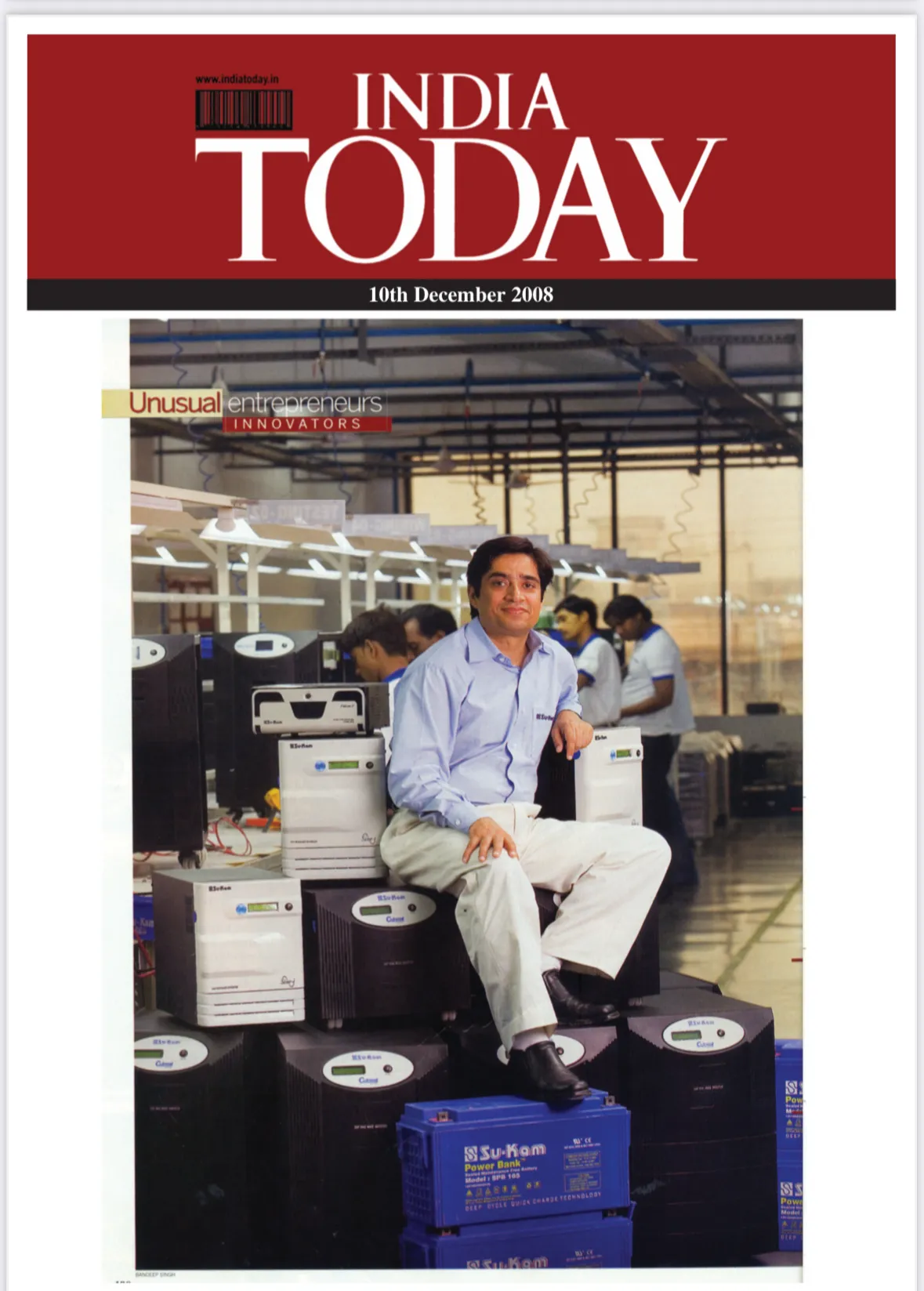
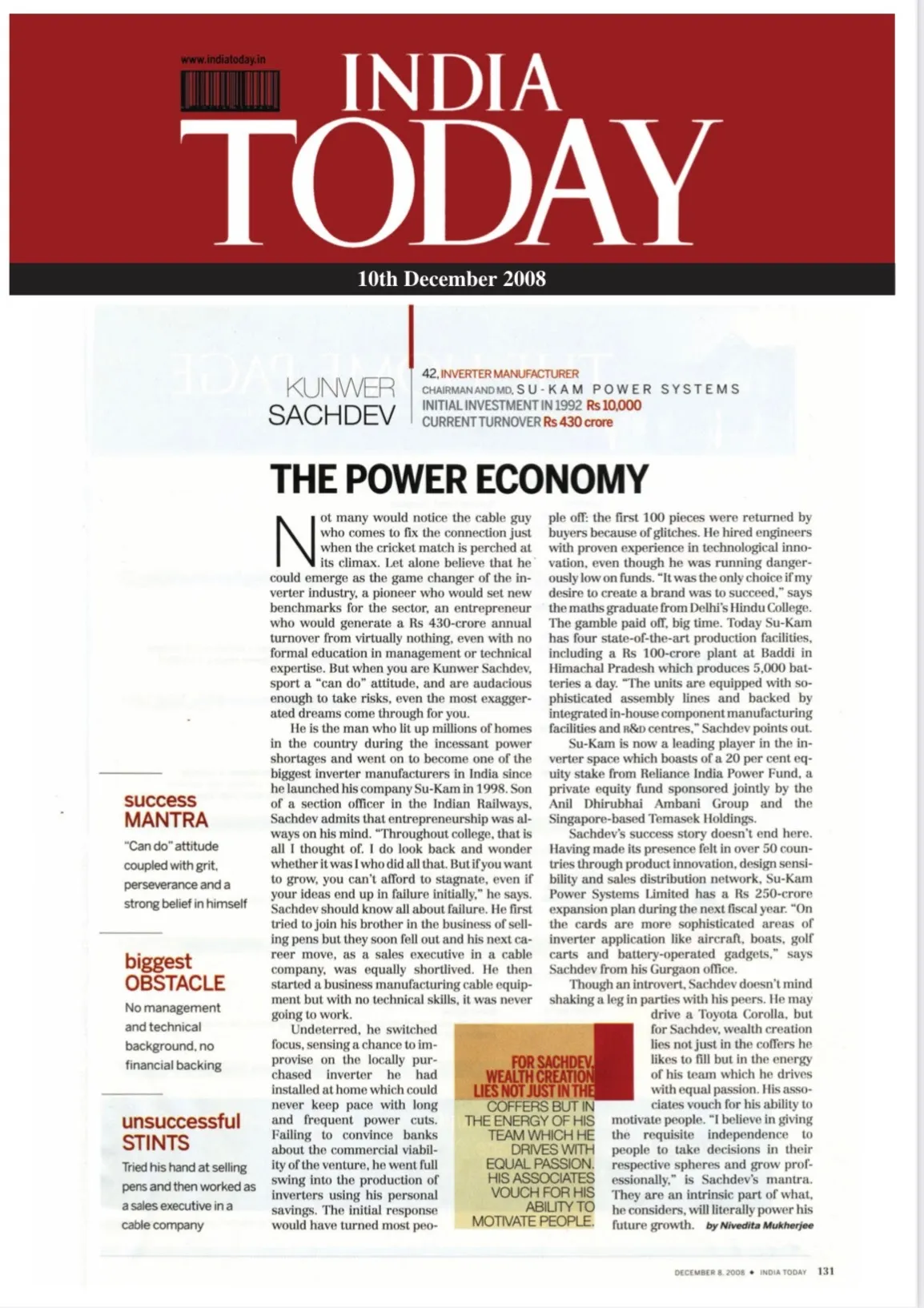
By 2008, Su-Kam's rise had drawn national attention. In its 10 December 2008 issue, India Today profiled Sachdev in a feature titled "The Power Economy," listing him among the magazine's unusual entrepreneurs and innovators. The article recounted how Su-Kam had grown from an initial investment of about ₹10,000 into a company with a turnover of roughly ₹430 crore, operating four production facilities — including a ₹100-crore plant at Baddi in Himachal Pradesh capable of making 5,000 batteries a day — and noted that the Reliance India Power Fund, backed jointly by the Anil Dhirubhai Ambani Group and Singapore's Temasek Holdings, had taken a 20 per cent stake in the business. It also captured his management philosophy: a belief in giving his team the independence to take decisions and grow.
The later chapters were harder. Su-Kam ran into serious financial pressure toward the end of the 2010s and entered insolvency proceedings, and by 2018 Sachdev's formal association with the company he had founded had come to an end. He stepped away — by his own account, not with regret but with purpose. For a builder, the closing of one chapter tends to reveal the next.
Today Sachdev mentors Su-vastika, the Gurugram-based energy-storage company founded in 2019 that he often frames as an evolution rather than a repeat of Su-Kam. Its focus is firmly on the future of power: solar power conditioning units, lithium battery packs, and advanced energy-storage systems engineered to replace noisy diesel generators and ageing lead-acid setups with quieter, faster-charging and more sustainable alternatives. The same problem-solving instinct that drove Su-Kam runs through the new venture, now aimed at the global shift toward clean energy storage.
Alongside it, Sachdev has made a bold move into artificial intelligence through Kunwwer.ai, where he is building practical tools — among them Slideflow.ai, an AI-powered presentation assistant intended to simplify how students, professionals and creators work. From power backup to AI, his career suggests that innovation is less a matter of industry than of mindset. He is featured today among India's notable entrepreneurs on Wikipedia — a quiet validation of a record built on relentless execution. And, much as before, while others are still talking, Sachdev tends to already be building.
Further Reading
The "Power Man of India" label grew out of a record that is well documented elsewhere. More of his story is documented on his Wikipedia profile and across SolarManOfIndia.com, while Su-Kam's company history — including the India Today "Innovation of the Decade" plastic-body inverter and its 70-plus patents — is recorded on Wikipedia. His latest ventures continue at kunwwer.ai.
News coverage of his journey includes YourStory on building India's largest inverter company from a Rs 10,000 start, Business Today's "Dark Horse" profile of his cable-TV-to-power-backup transition, and SiliconIndia on his shift toward solar.
Disclaimer
Mr. Kunwer Sachdev, the original founder and visionary behind Su-Kam, is no longer associated with Su-Kam Power Systems Ltd. He has not been involved in the management, operations, or decision-making of the company for several years. Any products, services, communications, or representations made under the Su-Kam name have no connection to Mr. Kunwer Sachdev. His current efforts are entirely focused on new innovations and ventures under different entities, including his latest initiative, Su-vastika, which is redefining the energy storage and power backup industry.
Disclaimer: invertermanofindia.com is an independent editorial legacy site.